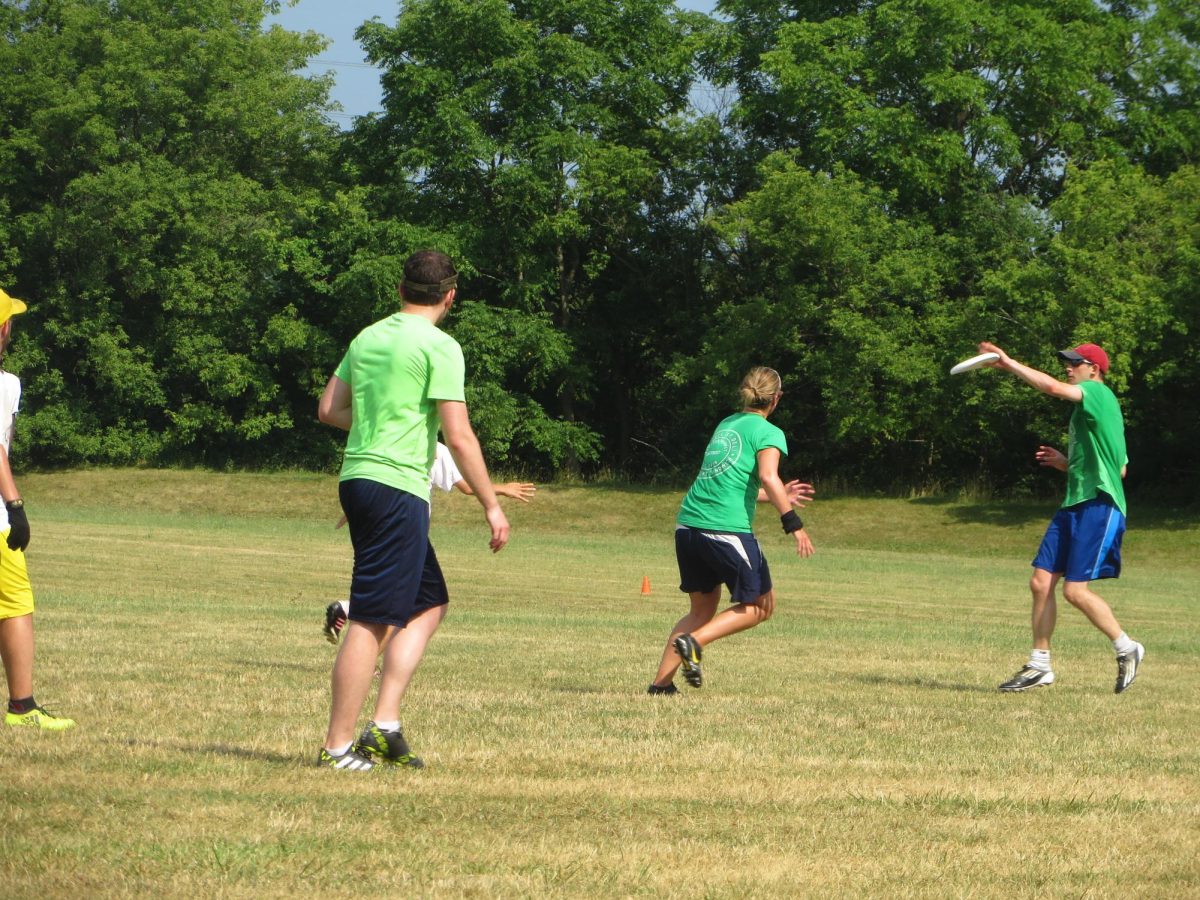
On a warm summer day in Ann Arbor, the fields at Fuller Park come alive with movement. Frisbees fly through the air, players sprint across the grass and laughter fills every corner. It’s here where Macry McCormick first fell in love with ultimate Frisbee—not because she was chasing competition, but because she found something deeper: a community built on spirit and connection.
“I got introduced to ultimate after college through some friends who played,” McCormick said. “They found out Ann Arbor had a co-ed league for people who just wanted to play, and they invited me to join.”
At first, it was just a way to stay active and socialize, but it soon became something much more meaningful. It was the mix of athletic challenge and connection that kept her coming back year after year.
McCormick grew up playing volleyball and basketball, both of which are structured, competitive sports with referees and rigid rules. Ultimate Frisbee, on the other hand, felt refreshingly different. There were no referees, no shouting from the sidelines, just players working together to keep the game fair.
“What drew me to ultimate was how welcoming the community is,” McCormick said. “The philosophy is all about teaching new players, even during games.”
McCormick loves that it’s non-contact and self-regulated. If there’s a foul, both teams talk it out and figure it out together, which makes it a good-natured sport.
That philosophy, known as the “Spirit of the Game,” is the backbone of ultimate Frisbee. It values respect, honesty and inclusion above all else, which is something McCormick thinks sets it apart from every other sport she has played.
“To me, it means positivity, respect and inclusivity,” McCormick said. “Everyone supports each other regardless of skill level. You’re not only cheering for your team but for the other team too.”
After the match, the teams separate into their respective huddles, often making up chants or cheers to celebrate their opponents.
When McCormick started playing in 2007, she didn’t know the support would shape so many friendships that would last more than a decade. Even as the original friends who introduced her to Ultimate moved away, the community she found through the sport kept her connected.
“I made so many friends through ultimate that it helped me come back,” McCormick said. “Even though my original friends moved away, I still have connections with people I met through the sport years ago.”
That sense of belonging — of showing up to the field and being surrounded by familiar faces has made ultimate a constant in her life, even when she has taken breaks.
“I didn’t play this season, but I played two seasons ago,” McCormick said. “Ryan Silvester [CHS teacher] and I were on the same team in the spring league. We have both been talking about how much we miss it and want to start playing again.”
Ultimate has a way of pulling people back in. The games are competitive but playful, the atmosphere light but energized.
“It is great exercise,” McCormick said. “And no matter who wins, both teams are supportive of each other.”
McCormick’s favorite memory of playing ultimate is something that she is very proud of: her first successful layout catch—diving through the air to snag the disc just before it hit the ground.
It was during a spring league game at Fuller Field when the ground was soft, and for McCormick, it was one of the best feelings.
McCormick has had many failed layouts, but that one stuck with her. Moments like that capture what makes ultimate so special. Whether it’s the thrill of a perfect throw or the shared laughter after a missed catch, every game leaves McCormick feeling more connected to her teammates and the game itself.
However, not every experience has been perfect. McCormick recalls one summer league season when a teammate took the competition a little too seriously, arguing over calls and disrupting the flow of the game.
“It dampened the spirit of the game for that season,” McCormick said. “But it also reminds me why that spirit matters so much. Ultimate only works when everyone buys into it.”
That commitment to candor and excitement extends beyond the field for McCormick.
“In ultimate, if teams are uneven, players are swapped so both sides are balanced,” McCormick said. “The goal is always to have a fair, fun and competitive game.”
It’s a lesson that has carried over into other parts of her life, including her current basketball league, where she sometimes finds herself missing ultimate’s ethos of inclusion.
“In basketball, sometimes we get completely outmatched,” McCormick said. “In ultimate, that would never happen.”
McCormick describes her ideal game as “two well-matched teams playing a close, competitive and fun game for about two hours.” There’s running, laughter, teamwork and a sense that everyone is working toward the same goal—not just winning, but enjoying the game.
For McCormick, the real win is connection.
“Just go for it,” McCormick said. “Even if you don’t know how to throw a Frisbee yet, people will teach you.”
Ultimate Frisbee might not have the same mainstream recognition as basketball or football, but to McCormick, it is already more than a sport. It’s a way to stay active, make friends and be a part of something uplifting — it’s not just a game, it is a reminder of community, respect and the power of play.