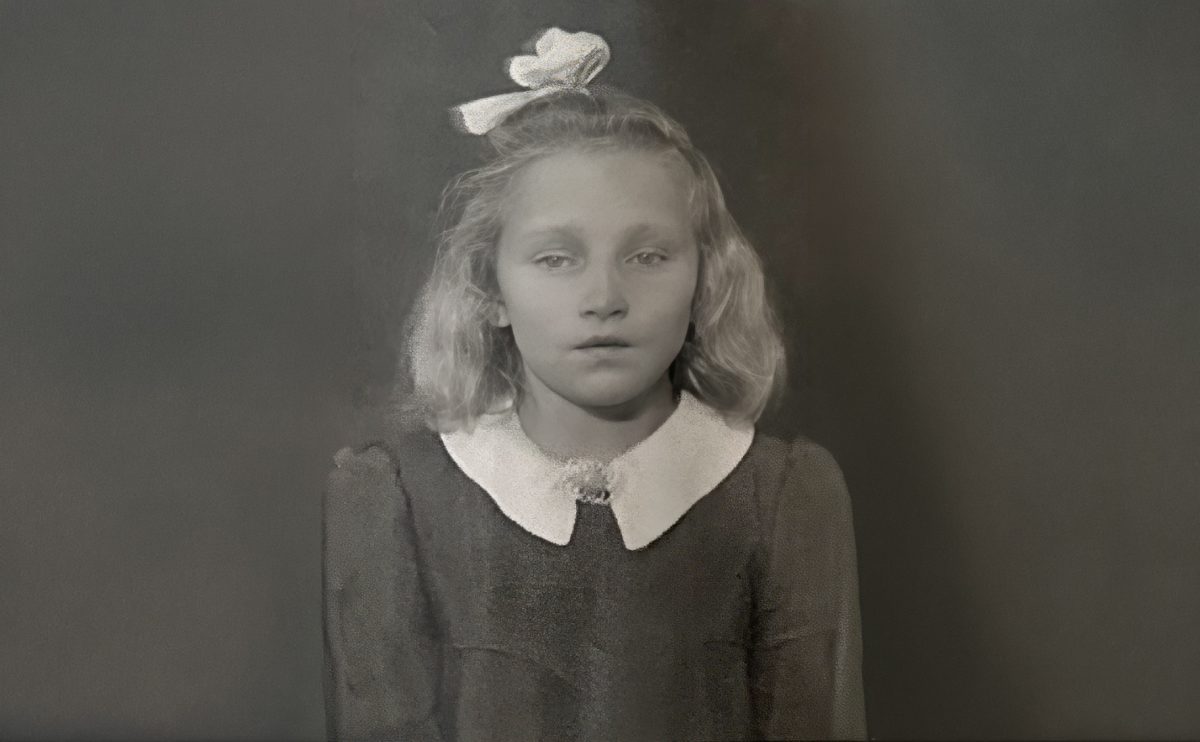
Cheers and cries ring throughout the camp. Soviet soldiers in long olive jackets march through the rows of barracks as children cling to their parents out of excitement or worry for what’s to come. For Maria Sochanski (now known as Mary Thomas) and her family, who were held in this camp, the liberation had come as a surprise after years of strenuous labor.
“For many other liberated people during the war, it was a moment of freedom and happiness, but for me, it felt like another trap,” Sochanski said.
Four years before their liberation, Sochanski and her family lived in the rural town of Tuczyn, Poland. Today, the settlement is known as Tuchyn, Ukraine. While Sochanski doesn’t distinctly remember the hometown, records indicate that agriculture, markets, local schools and religious groups such as Catholicism and Orthodoxy drove the Polish town.
On September 17, 1939, the Soviets began their first bombings, shootings and invasions on foot. Poland, Tuczyn was one of the first victims of these attacks. With most of Poland’s army along the western border defending against Nazi Germany, they had little ability to resist a second invasion on the opposite side of the country. By the end of the day, the USSR occupied Tuczyn, one of the first Polish settlements under Soviet control.
“Life was simple and peaceful to me before the Soviets invaded,” Sochanski said. “After they took over, my parents, siblings and I couldn’t do anything; they wouldn’t let us go anywhere.”
Immediately following the invasion, the USSR used the school systems as a tool to reshape daily life and promote Sovietization. The Polish curriculum in schools was abolished and switched to Ukrainian or Russian instruction. At the same time, religious education and Jewish symbols were banned to promote atheism and reduce the influence of religion in public life.
During Tuczyn’s occupation from 1939 to 1941, the settlement’s residents lived in constant fear of arrest, political repression and severe scarcity as the local economy deteriorated following its annexation. In order to receive basic goods every day, civilians had to wait in long lines that began at 4:00 AM outside local bakeries or cooperative stores. Staples such as loaves of heavy black bread, kerosene for lamps or salted pig fat and butter were distributed in limited quantities after hours of waiting. With each passing day, families like Sochanski’s focused solely on securing enough food and supplies to survive.
It wasn’t until June 22, 1941, that the Nazis launched Operation Barbarossa, seizing Tuczyn from Soviet control and beginning to send families to crowded ghettos or local forced-labor sectors.
“It wasn’t until this point that I fully understood what war meant,” Sochanski said. “Planes began to shoot at us on the regular, which had never happened before, and they would tell us, ‘Get down, we can’t be seen.”
During Soviet occupation, there were no active bombings or battlefield shootings, but with Nazi occupation, acts of violence like group shootings against Jewish communities, Soviet retaliation and massacres of Polish people became a common occurrence. Sochanski, along with other children, was trained through strict behavioral conditioning to remain silent and motionless for hours at a time, building physical stamina and psychological discipline.
After two months of Nazi control, many people were classified by their ethnicity, religion, occupation and perceived usefulness, which decided where families were deported. As ethnic Poles, the Sochanski family faced discrimination and the threat of concentration camps. However, Sochanski’s father, Julian Sochanski, fluently spoke German and was useful to the Nazis as a translator.
“I believe my father was classified as an ‘essential worker’ or ‘nutzjuden,’ which translates to a valuable Polish laborer. Then came what the Nazis called the ‘aktion,” Sochanski said.
The “aktion” were surprise roundups of people during street lockdowns or early mornings from July to September of 1941. A small group of Nazi police and local collaborators made their rounds through Tuczyn, eventually reaching the Sochanski’s family home.
“I was so scared,” Sochanski said. “They were holding huge guns, knocked down our door and started yelling at us in German but I didn’t have to speak the language to know we were being told to leave.”
The exact camp where the Sochanski family was taken remains unknown. All Sochanski remembers is that the labor camp centered on agricultural work. Having grown up in a farming family, she was familiar with working in the field, which shaped her future for the next three years in the camp. Julian Sochanski’s fluency in German allowed him to serve as a translator for camp officials.
Before sunrise every day, Sochanski, her sister Irina and her two brothers, Jan and Kazimierz Sochanski, woke in crowded barracks, often tired from the day before and hungry from the one meal they were fed each day. The children slept in tight quarters separate from the adults in the camp, but their work was no different from that of their parents.
For Sochanski, a day began at 4 or 5:00 AM with Nazi guards blowing ear-piercing whistles that rang throughout the barracks. The children were marched outdoors, standing in a single-file line while being counted over repeatedly. Breakfast was usually a single chunk of hard, heavy black bread and a bitter cup of coffee made from roasted acorns.
“I lost a fair amount of weight during the war, but especially while in the camp, and even after, it took a while before I put any weight on,” Sochanski said. “I remember that the clothes I wore were far too large for me. They didn’t let us bring any clothes with us, but we didn’t wear uniforms either.”
Wartime hunger followed Sochanski from Soviet occupation to the Nazi labor camp. For decades after WWII, Sochanski believed that she was born in 1938 until she requested her birth certificate from the Polish consulate, which revealed she had been born in 1936. According to Sochanski’s family members, her mother intentionally lied about Sochanski’s age for her to qualify for milk and other assistance programs exclusive to the younger children. The risk that came with her mother’s deception reflects the condition that the prisoners were living in.
Depending on the labor camp where Sochanski and her family were held, they may have marched miles outside the compound while led by guards with whips or rifles before reaching the surrounding fields. Although many of the prisoners were children, the Nazis expected adult-level labor. During the Summer, Sochanski spent 12-14 hours pulling weeds, digging up potatoes, harvesting grains and loading heavy crates into wagons every day. If Sochanski slowed down from exhaustion, she risked being beaten by the close-watching Nazi guards. If she dared to eat a raw vegetable from the fields, it was considered theft from the Reich and was punishable by death.
On the opposite end of the camp, Julian Sochanski translated work assignments, schedules and punishments between Nazi officials and Polish laborers. When translation duties were not needed, Julian Sochanski’s experience as a farmer was put to use when he was forced to join the other prisoners in the fields.
After three years of the camp’s prisoners working nonstop, Soviet forces made their advances towards eastern Poland during the summer of 1944. Sochanski, unaware that the USSR was inching closer, continued with her daily orders and instructions. In surrounding labor camps and concentration camps, aware of the Soviets’ advances, many guards fled or forced prisoners at gunpoint further into German-held territory. In this sense, the Sochanski family was lucky. The Soviet advance had been so swift that the Nazis fled before they could kill or relocate any of the prisoners.
With the Red Army’s hostile entry into the crowded camp, Sochanski recollected the familiar aggression of the Soviets in her hometown.
“We were liberated,” Sochanski said. “We weren’t saved.”
Although the camp’s prisoners were unfettered from Nazi control, their freedom was far from secure. Liberated prisoners were still starving, injured and surrounded by a war zone. The Soviets also considered anyone from territories they controlled as Soviet citizens, sending anyone who survived under the Germans east to rebuild the USSR. Many feared that after suffering several years under Nazi control in labor camps, the Soviets would do the same, placing many in labor service to rebuild the war-torn country.
To resist being relocated deeper into the Soviet Union, Julian Sochanski likely used his language skills to claim that the family was from Western Poland or another region outside of direct Soviet jurisdiction.
After escaping Soviet control, the Sochanskis arrived in Bavaria, Germany, where the Americans operated an assortment of displaced persons camps. To enter one of these camps, the Sochanskis had to go through strict, multi-day assemblies and screening procedures run by the U.S. Army and the United Nations Relief and Rehabilitation Administration.
Once the Americans approved the family’s paperwork, each person was assigned a DP index number and an official camp destination.
“I remember walking into the displaced persons camp and seeing the American soldiers, and I ran to them, and I hugged and thanked them. I was so grateful to have someone to thank for our freedom, finally,” Sochanski said
Today, Sochanski wishes people would recognize that her family’s suffering didn’t begin in the Nazi labor camp. She witnessed her hometown being stolen by Soviet forces, altering the daily lives of many families, including her own. While history often remembers the USSR as part of the force that defeated Nazi Germany, Sochanski introduces an alternate view.
Now, eight decades after the USSR’s occupation, Ukraine finds itself lying in the same region as Tuczyn, defending against the aggression of Russian forces. For Sochanski, the recent headlines, news broadcasts and images of the war are reminders of the struggles she and the Ukrainian children of today face daily.