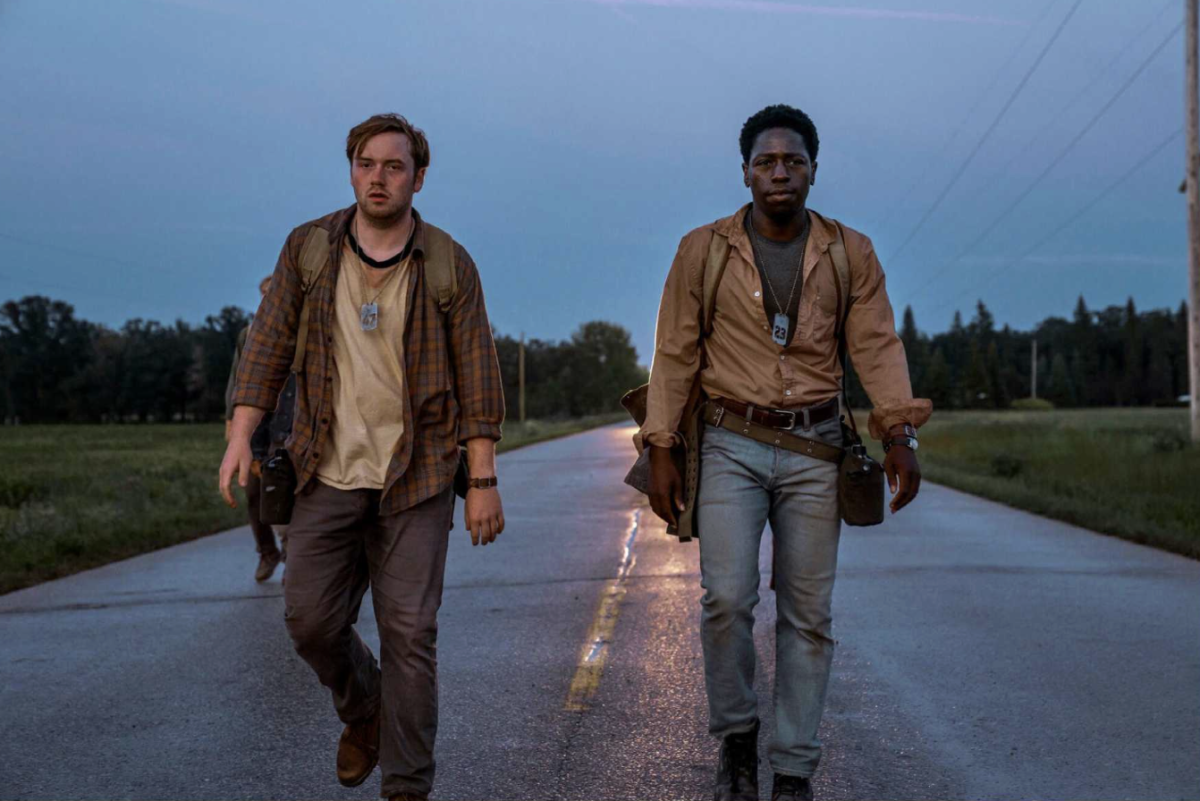
Adapted from Stephen King’s first completed novel, “The Long Walk,” Francis Lawrence’s film captures the harrowing limits of human endurance. In the aftermath of a devastating war and amid a crippling economic depression, the nation turns to a twisted form of entertainment to lift morale. A ruthless military leader known only as the Major, played by Mark Hamill, introduces The Long Walk — a brutal contest designed to combat what he calls an “epidemic of laziness.” The rules are simple but deadly: 50 teenage boys, one from each state and chosen by lottery, must walk without stopping. If their pace drops below three mph, they’re executed on the spot. The last walker standing earns a massive cash prize and one wish of their choosing.
The start of the film introduces the protagonist, Ray Garraty, a 16-year-old boy from Maine, played by Cooper Hoffman. On the first day of the walk, Ray meets Pete McVries, played by David Jonsson, who quickly becomes his closest friend throughout the grueling walk. The movie showcases the evolution of their friendship while exposing details of their background. Pete was brought up as an orphan; he represents hope and faith in a time of struggle. Ray’s motivation, however, is rooted in vengeance. His father rebelled against the Major’s corrupt regime and faced execution for it. Ray’s wish if he wins is to kill the Major and end the game.
While the story carries potential to be a powerful commentary on humanity, control and societal divides, the characters feel underdeveloped, and the violent graphics distract from the actual storyline. This film is gruesome and horrific, and the plot is poorly executed through repetitive scenes and a lack of world-building.
The ending of the movie diverges significantly from the original ending of the book. Ray and Pete are the last standing players in the game in both versions. In the book, Ray takes the win but continues walking, absorbed by the trauma and exhaustion the walk put him through. The movie takes a different approach: Pete tries to quit so that Ray can take the win, but Ray sacrifices himself instead, leaving Pete with one wish. He uses his wish to fulfill Ray’s desire for revenge by killing the Major. The last scene of the movie is Pete walking into the darkness. This ending is anticlimactic and disappointing. It left us with numerous questions, and we wish we had gotten insight into more of the aftermath.
Ultimately, Francis Lawrence’s “The Long Walk” is visually gripping but underdeveloped in terms of storytelling. Its haunting visuals leave the viewer in emotional distress, while it could have been a standout.