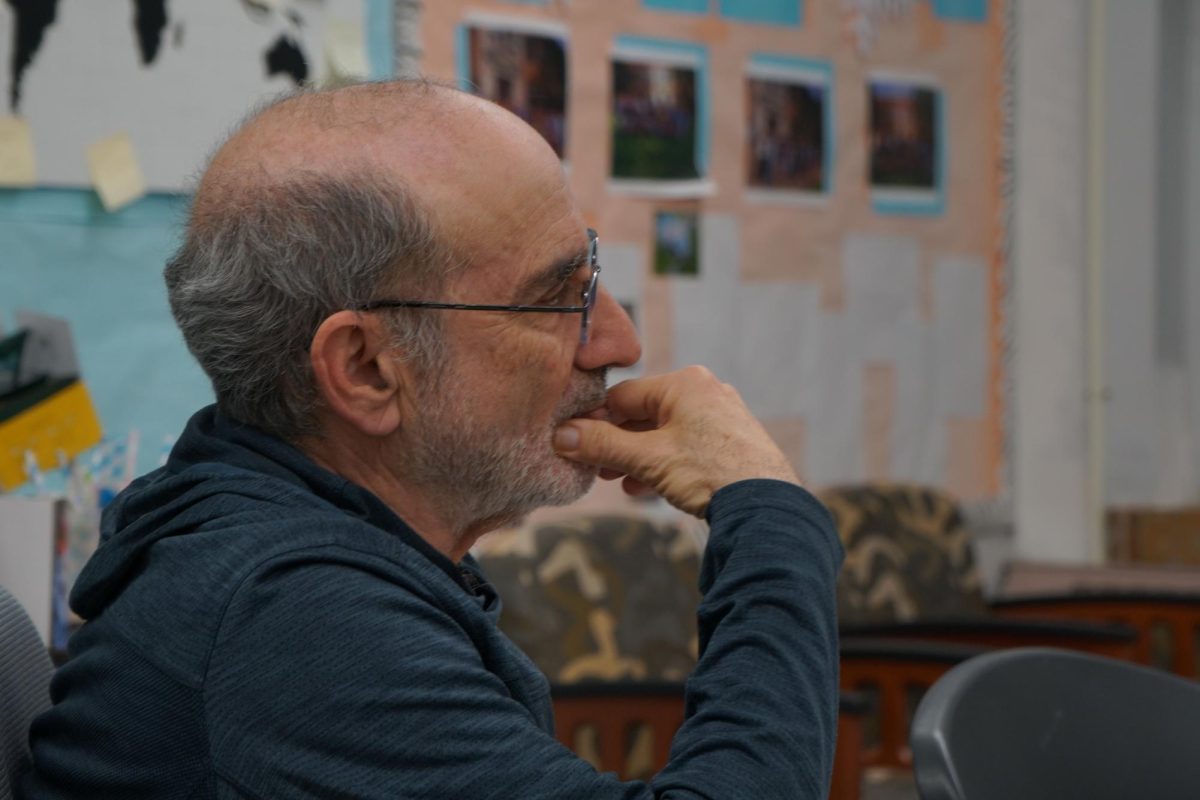
A plastic disk flew through the air, held aloft only by the motion of its spin, until it tumbled into the hands of Judah Garber. When Garber, a retired lawyer and high school mock trial coach, joined an Ultimate Frisbee pickup game in the park near his house, he had no idea that he was about to stumble across a group that would change his life forever.
The mission of HAC (Homeless Action Committee) was to advocate for more low-income housing for Ann Arbor residents. Even after the committee dissolved, its Ultimate Frisbee group stayed active, often playing pick-up games near Burns Park (coincidentally Garber’s neighborhood). The leader of the HAC was a political activist who ended up as the original facilitator for the Ann Arbor chapter of Indivisible shortly after it formed, and after becoming good friends through Frisbee, he introduced Garber to Indivisible.
Indivisible is a group of loosely knit cells around the country that formed when Donald Trump was first elected to office, and it grew quickly. The organization isn’t just about opposing Trump, but also pushing the Democrats to do better.
“It was a nonpartisan organization,” Garber said. “During the Biden regime, it wasn’t the same kind of thing, but we were still pushing them and our local representatives to do what we consider to be better, to work harder, to protect people’s rights and push policies that we believe in, that they weren’t being sufficiently active in promoting or defending.”
Garber retired around the pandemic but worked a few blocks from CHS as part of the county court system. At the domestic relations arm called “friend of the court,” he worked in many different roles, including as a staff attorney, referee, mediator, arbitrator, hearing officer and administrator.
“Even though government employees have the same first amendment rights as court employees, as a director with a public name or whatever, I felt a little constrained from being as publicly active as I had been at other times,” Garber said. “Not like anyone said to me, ‘Oh, you can’t do this or that,’ but it just seemed like it was better to keep a lower profile and do things that weren’t right on the front lines or do more behind the scenes type of things.”
After retiring, Garber made a return to his activist roots. Now, he is a lot more comfortable being on the front lines, and feels like everyone needs to be, to some extent. For the last nine years, since the first Trump administration came into power, Garber has amped up his efforts with the local Indivisible chapter. He also sits on the upper Human Rights Commission as a commissioner, through which he helps to enforce ordinances.
“Talk to the people that represent you, because that’s where you’re more effective,” Garber said, “whether it be local or your U.S. congressional representatives or senators. We don’t write letters to the president. That seems like a waste of time, but your members of Congress might have some sway with the president if they’re of that president’s party, so that kind of thing.”
“That kind of thing” comes naturally to Garber. He came from a family of social workers who raised him with an ethos that emphasized social involvement. The first big march he attended was the Poor People’s Campaign, also known as the Poor People’s March on Washington, which took place shortly after the assassination of Martin Luther King Jr.
“My parents took me to ‘Ban the Bomb’ youth demonstrations when I was little,” Garber said. “That kind of got in my blood.”
For someone like Garber, it’s hard to pinpoint the exact causes of apathy or inaction; he refers to it as the “million-dollar question.” His answer?
“I don’t know,” Garber said. “I don’t know the answer to that. I wish I knew the answer. Is it because [people] don’t feel that they can have an impact? What’s the alternative? To do nothing, and then just let things happen? That’s not good either. I feel like there’s not much choice but to do things.”
Garber thinks there are opportunities to resist and be effective, but people aren’t feeling it. He has noticed that even throughout history, when most people weren’t directly affected by what was happening, they didn’t notice it. If they didn’t care about what happened to their neighbor, they could go on living their lives more or less as they had been.
“I’m afraid there’s a lot of that going on,” Garber said. “People don’t appreciate what’s happening to their neighbors, their fellow citizens, fellow non citizens, who live here and have lives.”
People might not see that their lives are at stake. People may feel powerless. They don’t think institutions can fight back, or that what they do makes a difference. Garber disagrees with that feeling. In fact, Garber still believes people can work within the system to create change. He isn’t naive; he doesn’t believe that every system is great and is easy to change, and so forth. But he believes that there is an opportunity to make a difference.
“There is hope that you need to keep,” Garber said. “You have to act as if it’s going to work, and if you don’t, then, of course, it won’t work. Doing nothing never works. Doing something might work and might increase your chances.”
Garber has faith in the younger generation to continue fighting, and he believes that as they wake up to unavoidable issues, they are going to push back.
“I have faith that things will get better over time,” Garber said. “These things go in cycles, and I think we’re going to a low ebb, but I think that things will improve over time through the efforts of all people, and especially young people.”
Either way, Garber isn’t going to stop. Fighting for justice is a never-ending battle, and he is up to the challenge.