

Hayao Miyazaki is one of the few filmmakers whose name alone can pull audiences into a theater. Studio Ghibli, founded by Hayao Miyazaki, is so big (there’s even a “Ghibli World” theme park in Japan). And across many years, their films have connected with audiences worldwide. So when “The Boy and the Heron” finally arrived in 2023, seven years after production quietly began in 2016, did it fulfill its decade’s worth of anticipation?
“The Boy and the Heron” is about Mahito Maki, a young boy living in Tokyo during World War II. When an air raid kills his mother, his father moves the family to the countryside in hopes of finding safety. Two years pass, and Mahito’s father has married Natsuko, a woman who eerily resembles Mahito’s late mother, and who is now pregnant.

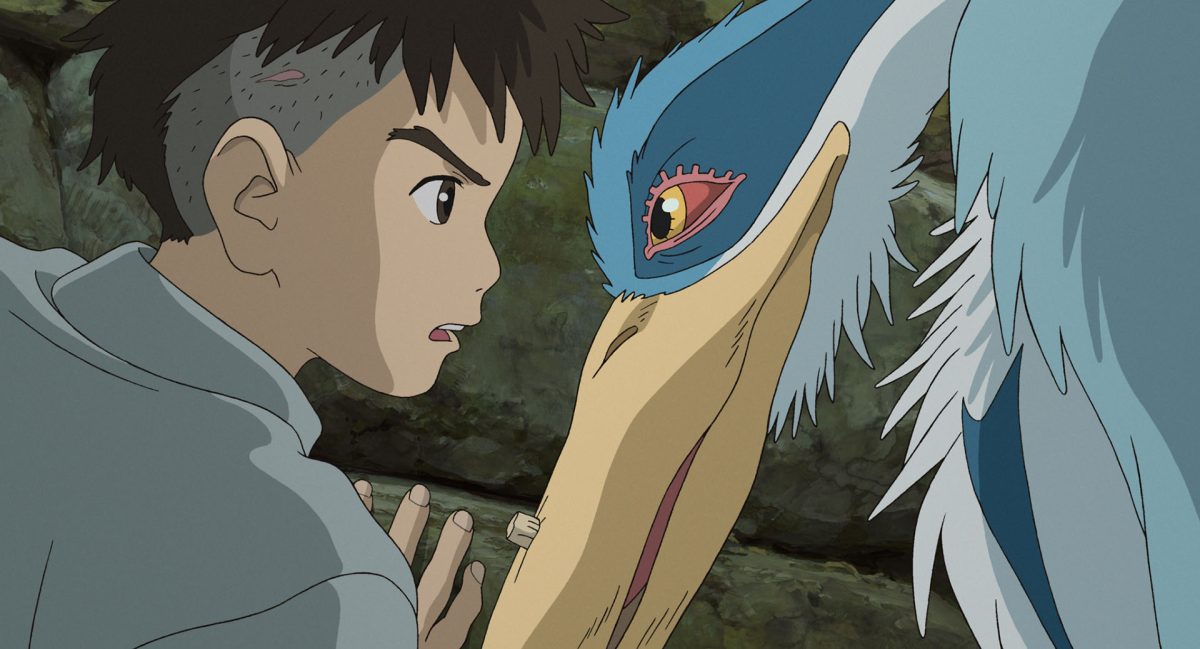
Feeling lonely, bored and unable to connect with the other kids at school, Mahito spends his days wandering the vast property around their new home. During one of these wanderings, he encounters two things that will pull him into an unexpected adventure: a strange grey heron and an abandoned tower built on the estate decades ago. After the heron tells him that his mother is waiting for him, and Natsuko suddenly goes missing, Mahito must enter the mysterious tower and uncover the hidden truth inside.
To start with the positive, this movie excels at recreating the atmosphere that has become synonymous with Studio Ghibli. This is most evident in the second half, where the swelling orchestral music, painterly landscapes and whimsical creatures — all a part of the Ghibli formula — return and, for the most part, still work beautifully.
But even the strongest animation and music can’t distract from the film’s pacing issues or the strange contrast between its first and second halves.
The film’s opening hour is not what you’d expect from a Studio Ghibli film. It’s slow, even unsettling at times, as if they are building toward something dark and mysterious. For example, once Mahito settles in at the countryside estate, strange things begin happening. He’s attacked and taunted by a grey heron claiming his mother is waiting inside the tower, but he can’t tell whether he’s hallucinating or not. Natsuko and the elderly women who manage the grounds seem to know more than they’re willing to admit, and when Natsuko disappears into the forest and doesn’t return, the film leans fully into its eerie tone.
Or so I thought.
When Mahito enters the fantasy world inside the tower, the film becomes exactly what you’d expect from Ghibli, but flatter, simpler and surprisingly shallow. After nearly an hour of setting up an intriguing mystery, the sudden shift into a basic adventure quest is unsatisfying. And the world-building that’s meant to deepen this realm is, frankly, bewildering.
Let me try to explain it as clearly as the movie does: the tower’s world is powered by a magical asteroid that crashed there decades ago. One of Mahito’s ancestors discovered it and used its energy to construct this pocket universe. This world also exists outside the normal flow of time, which is how Mahito meets his mother as a child. You see the problem. It’s imaginative, but worldbuilding is confusing for no reason.
In the end, “The Boy and the Heron” isn’t bad, but it’s far from great, nostalgic films Ghibli made a couple of decades ago. Even though it may not be another “Spirited Away” or “Howl’s Moving Castle,” it’s still worth a watch. The animation is gorgeous, the music is stunning and there are moments where that classic Ghibli magic still shines through.


