In her freshman year, when Maggie Williams entered her forum leader, Jessika Whiteside’s, room to eat lunch, she found most of the occupants invested in writing. She usually ate with her longtime friend Josie Simpson, but couldn’t find them today. As she ate her lunch with Writer’s Club, she decided to write along with their prompt for the day: “You are a judge at a pie contest. Unbeknownst to you, one of the pies is poisoned.” But she didn’t just respond during lunch; after school, she spent another half-hour writing her story.
When Simpson returned to school the next day, Williams told them all about her writing experience and her interest in the club. So the next time the club met, Williams returned, bringing Simpson along with her. Now, both Williams and Simpson are seniors and the leaders of the Writer’s Club.
Writer’s Club at CHS meets in Whiteside’s room every Tuesday at lunch, where members are given a prompt introduced by club leaders. Toward the end of the lunch period, members often share what they wrote with one another. There is one goal at every club meeting — to have fun writing. Williams and Simpson strive to create an environment where no one is pressured to share what they have written but can do so in a safe space.
“Writer’s Club is more of a chill experience,” said Della Scudder, a member of the Writer’s Club. “You can keep your writing to yourself and feel however you feel about it, but positive comments and other people seeing it are really nice things.”
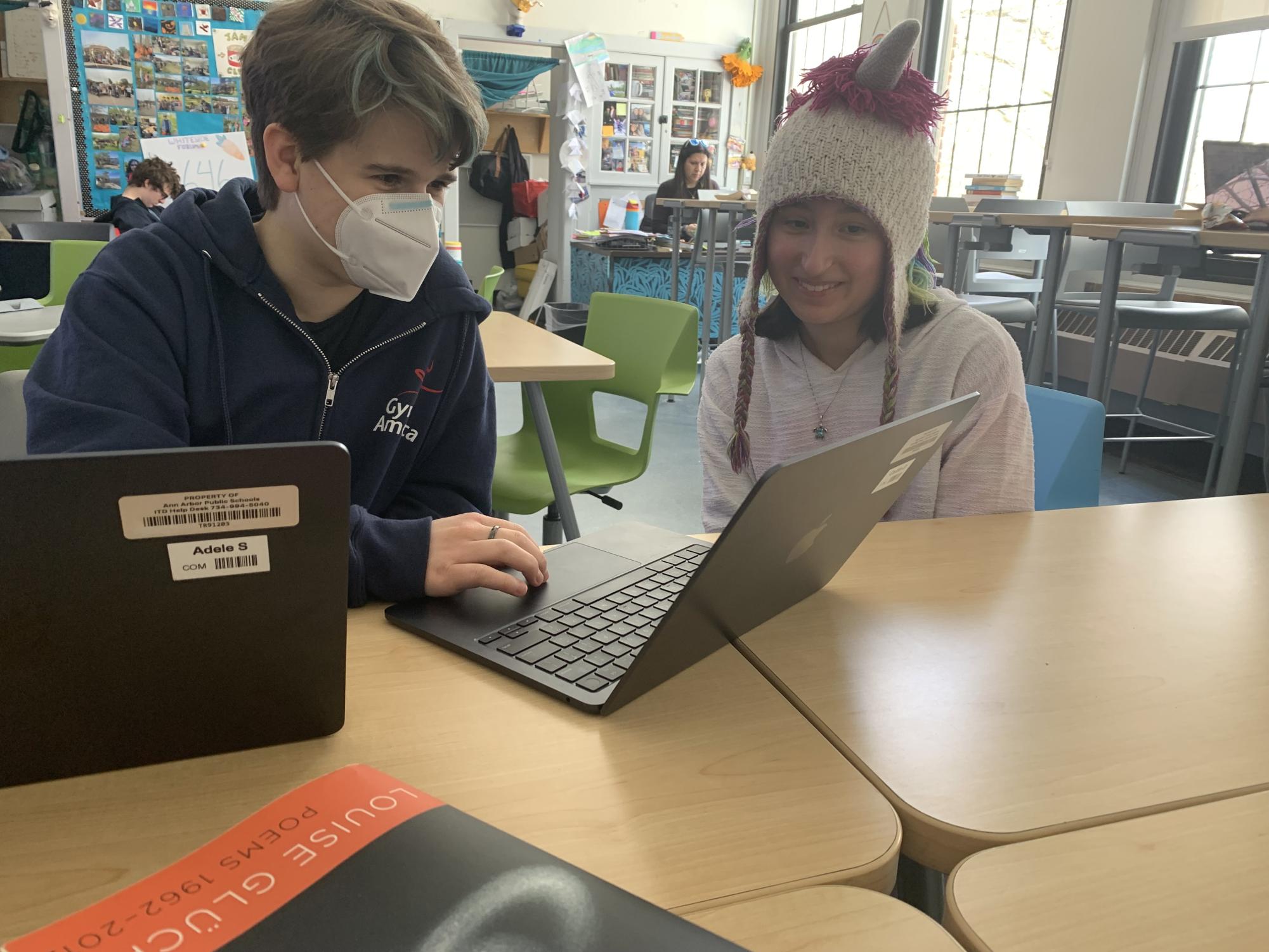
Previous writing prompts have included “The way we decide the president is now a lottery system rather than an election,” and “You’re a therapist in the real world, and your clients are all fictional characters from different worlds.” From these prompts, members have written short stories, back-and-forth dialogue and even business letters. Caitlin Dick-Ruíz, CHS junior and member of the club, shared a section of her story responding to the first prompt.
“… the ONLY option this year is to pick a candidate based on their shoe size. Yes, you heard correctly. They are going to be picked based on if the official shoe fits them! A group of politicians will travel from house to house for one day until they find someone. After that, the person chosen will be president for one month. After one month, a new candidate will be picked and so on and so forth. Isn’t this a wonderful idea we’ve come up with?” (“Presidential Lottery” by Dick-Ruíz)
Williams loves choosing these prompts with Simpson. She sees the creativity it brings to the members and enjoys hearing others’ works.
“Choosing the prompts is probably my biggest role, since I want to choose something that everyone will enjoy writing to and that fits our group vibe well,” Williams said. “This year, I’ve challenged myself to make up my own fun prompts.”
Despite being one of the leaders of a creative writing club, Williams doesn’t write much now outside of the club, preferring to read fiction books in her spare time. Through all of this reading, she has gained a strong sense of what good creative writing looks like. However, as helpful as reading fiction can be, Williams often struggles with the open-ended nature of writing. She finds it hard to get her ideas onto the page unless she feels her work will match the quality of the authors she admires, largely because she considers herself a perfectionist. Williams’s perfectionism also makes her worried and frustrated when her ideas don’t come out quite right. She feels that writing presents far more possibilities than subjects like math, so she tends to find her assignments in those subjects easier than those in literature.
In Writer’s Club, though, she reminds herself that she can leave her worries behind. The pressure is low, and the subject matter is fun. She realizes that many writers also write for fun, even if they write longer and more frequently. But she doesn’t feel out of place in the club because her goal is to encourage others to write things that make them happy, just like she’s learned to do.
For Scudder, just like Williams, writing inside and outside the Writer’s Club can be very different. The club is a space to do smaller pieces of writing for fun, using an interesting prompt that gets their brain thinking. Before they joined the club in their sophomore year, they used to like writing poetry but not sharing it. They think they’ve always been good with words, but it was in middle school when they really started to enjoy writing.
“I think part of the beauty of Writer’s Club is that you get this time to just work on it a little bit, and then you’re done at the end of the block,” Scudder said. “There’s no pressure to have this whole big thing that haunts you.”
Another club at CHS that focuses on student creativity with words is the Poetry Club. Cypress Milligan, a senior in the Poetry Club, has participated for all four years of their time at CHS and has written poetry for longer. Poetry Club focuses on the reading, writing and sharing of poems. Outside school, Milligan helped revive the literary branch of the local teen center, The Neutral Zone, and started Unbound, the poetry program there.

“[Writing poetry] is more of a lifestyle or perhaps a philosophy to me,” Milligan said. “It’s just how I process complex things in life, how I make connections. It’s ingrained in who I am.”
A Poetry Club meeting usually starts with a reading of one or more poems. The members talk about how it makes them feel or think, what the writer is doing and how the poem is structured. They then write their own poems and share their drafts at the end.
Milligan loves sharing their poems. They deliver their poems to the public whenever The Neutral Zone hosts an event, including a poem reading. Unbound helps organize readings as well as help the members write their poems. Milligan sometimes builds out their drafts from Poetry Club or writes a similar poem to share at The Neutral Zone.
“The art of poetry isn’t just fancy writing,” Milligan said. “It’s to aspire to be able to make somebody else feel something and not just the description of the thing. It’s about taking the abstract feelings that you can’t really put into words and managing to make a series of images and statements that don’t say it, but do convey it. There is some sort of shared feeling between the writer and the reader that can’t really be explained.”
Williams, Scudder and Milligan have all put pressure on themselves as writers and have high expectations of their work. But despite the challenge, writing in this fashion helps all three prepare for the future. To Williams, writing is more of a hobby at the moment. She anticipates needing to write in her future job, but doesn’t want to dive too deeply into it because she likes the amount of challenge she already gets and doesn’t want to add more.
Scudder felt pressure when they were younger, often struggling to share their writing with others. Now, they found that receiving feedback on their writing, even their college essays, made their writing stronger. Sometimes it’s difficult for Milligan to start their poems and come across ideas that they like because of their high expectations, but they’ve still been able to develop their style of writing, which helps one stand out as an artist.
Creative and poetry writing may seem different on the surface, but they can be similar at times. They both have short stories or long poems. Both need the development of an idea, whether it be character development or image and emotion, and both need a source of inspiration, passion and creativity to do it well.