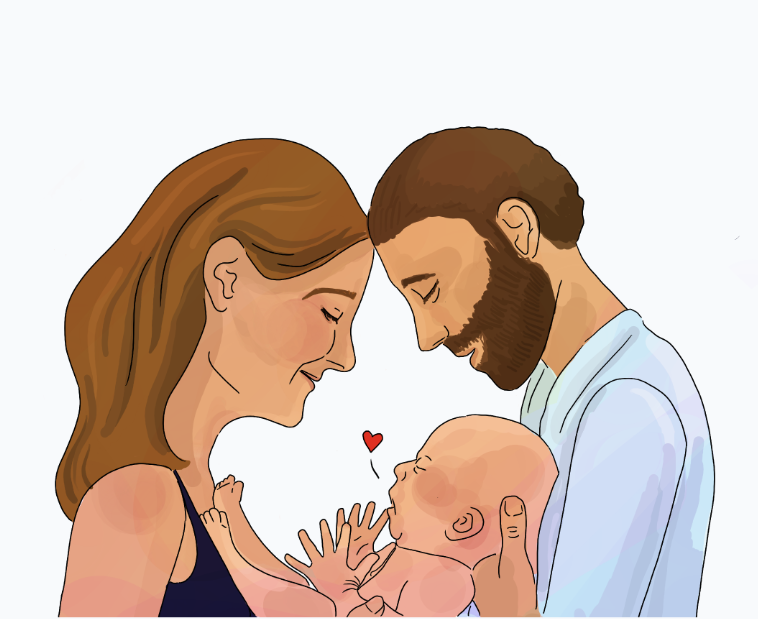
When Ashley Waddell Tingstad’s third child was born on Jan. 8, 2022, the mood of the operating room instantly shifted. Everyone knew something wasn’t right.
With this child, she wasn’t anticipating anything different than what she’d already experienced.
“It wasn’t really until after the moment that he was born that everybody realized that there was something really special about Viggo, and we didn’t know what it was,” Waddell Tingstad said. “That was a very scary moment.”
A few weeks after Viggo was born, Waddell Tingstad and her family received the results of Viggo’s full genetic screening: Viggo had trisomy 5p, a rare chromosomal disorder. He was one in one hundred million.
“It was already extraordinary just to have him with us because of his condition,” Waddell Tingstad said. “So few children made it to birth, and there was not much written about it in medical literature.”
When she got the news about Viggo’s condition, her entire life was turned around. At best, Viggo would be severely disabled and dependent on machines his entire life, and at worst, he wouldn’t live beyond his first year.
“That really threw me into a completely different life,” Waddell Tingstad said. “I was on a different planet of motherhood, and I didn’t know which way was up or down. The rules of gravity didn’t apply.”
After learning about Viggo’s diagnosis, Waddell Tingstad was able to connect with a few other moms who were also raising children with trisomy 5p.
Waddell Tingstad learned about the prognosis for trisomy 5p and all the severe and painful measures used to keep the children alive, including the use of tracheostomy tubes and ventilators.
Waddell Tingstad wondered how she could make these medical decisions for Viggo.
“He can’t tell me what he wants, and I don’t want to play God,” Waddell Tingstad said.
2022 wasn’t the first time Waddell Tingstad had to face the loss of loved ones.
In 2018, Waddell Tingstad’s dad and uncle passed away a week apart from each other. While her dad died at home surrounded by love and warmth, her uncle died in a hospital surrounded by doctors and nurses. These contrasting experiences greatly influenced her thinking about Viggo’s end-of-life care.
Waddell Tingstad vividly remembers a doctor asking her about what her goals were for Viggo. She was confused. Goals? She couldn’t understand what goals she could have for a child so fragile and delicate.
“How do we figure out a framework?” Waddell Tingstad said. “I’m a lawyer, and I like frameworks. I wanted to figure out all the different elements and facts I should consider when making decisions for Viggo.”
Waddell Tingstad came to understand what the doctor wanted her to decide: Would Viggo and his family go down the curative path, pursuing all treatments available, or would they focus on palliative care, which is centered around quality of life?
Amidst all the many complicated choices, Waddell Tingstad only wanted Viggo to feel safe, loved and comfortable.
“None of the surgeries were going to cure his trisomy, which was affecting every cell of his entire body,” Waddell Tingstad said. “There was a really, really tough road ahead, no matter what.”
Waddell Tingstad and her family chose to follow the palliative path, while also taking advantage of Michigan’s Concurrent Care program, which allowed Viggo to receive curative care options as well.
Waddell Tingstad and her family knew that they wanted Viggo to come home. Considering that Viggo was born during the height of the pandemic, when strict regulations limited visitors to the Neonatal Intensive Care Unit, Waddell Tingstad’s older children didn’t get to meet Viggo until he was 40 days old.
“They weren’t going to know their brother, and Viggo wasn’t going to know them unless we got him home,” Waddell Tingstad said. “I knew that everybody needed to be together.”
Waddell Tingstad’s family was committed to enriching Viggo’s life. They found a boat battery that would keep his medical machines going while on the road. They would take walks around the neighborhood, even attending Music in the Park in Plymouth.
“We wanted him to experience our world, and we wanted to experience it with him,” Waddell Tingstad said. “We wanted everybody to get a chance to meet Viggo and hold him. When people held him, he would hold people’s fingers and gaze into their eyes, with the most amazing gaze. It was so special. It gave us so much joy to share him with our community and for his brother and sister to get to be with him.”
In July, six months after he was born, Viggo’s quality of life worsened. His family decided to move him to the Transition Room at Mott Children’s Hospital, a place designated for end-of-life care. Transition rooms offer a peaceful, home-like alternative to an intensive care unit, focusing on comfort, family presence and holistic support for children nearing death. After six months of a love-filled life, Viggo passed away with his family around him.
“He was held almost his entire life by loving arms, and that makes me really happy as his mom,” Waddell Tingstad said.
After Viggo’s death, Waddell Tingstad converted his old room at home into a meditation room, and although they cleared out many of Viggo’s possessions, they kept his changing table. Her family turned it into an altar, filling the drawers with memory boxes, favorite blankets and toys. Together, as a family, they would make it a ritual to sit on the floor and look through Viggo’s belongings.
Waddell Tingtad soon became an advocate for pediatric palliative care. She served as a parent champion for the Courageous Parents Network, an organization focused on orienting, equipping and empowering families and others caring for a child with a serious medical condition. With the network, she wrote blog posts about palliative care and recorded audio stories with her husband, Theron. She continues speaking with doctors and nurses to share Viggo’s story and raise awareness of trisomy 5p.
“Every time, I’ll carry a memento from Viggo — he comes with me,” Waddell Tingstad said. “I don’t know how these interactions will ripple out into the world, but I hope that they make one person’s journey just a little bit easier.”
To help support others’ journeys, Waddell Tingstad now serves on the board of the Children’s Palliative Care Coalition of Michigan, where she works to increase opportunities for palliative care for children across the state.
“I feel like my life is so much richer for having Viggo in it,” Waddell Tingstad said. “I wish he were still here as an almost four-year-old, but I’m just so grateful that he’s my son. I miss him.”
In the future, Wadddell Tingstad hopes to write a book about her experiences and start a foundation, all in honor of Viggo. Most of all, she hopes to continue the conversations about Viggo and trisomy 5p.
“Viggo opened up a totally new world for me,” Waddell Tingstad said. “He connected us with so many people that I just love so deeply.”
Considering the impact Viggo had on Waddell Tingstad and her family, and the tremendous ways Waddell Tingstad has advocated for families within and beyond our community, Viggo truly was one in one hundred million.