Mak Weber
Mak Weber wasn’t always confident about her curly hair. When she was younger, she didn’t know as much about her hair, which made her feel less confident.
“I’ve always had curls, and I didn’t know how to take care of them,” Weber said. “So, growing up, I struggled with that. I feel very confident in my hair now because I know how to take care of it, and I dye it myself, so I can change it whenever I want.”
Weber enjoys dyeing her hair and finds that it brings her even more self confidence in her day-to-day life, especially since she is able to dye her hair on her own.
“I just like colored hair,” Weber said. “It’s just something that I can change and control.”
Weber identifies as mixed race, and feels that her curly hair helps her connect to her dad’s side of the family, who are African American.
“I don’t really have a strong connection with my dad’s side. So it’s like a connection I have to that side of my family,” Weber said. “It’s part of who I am.”
Weber is also a part of the cosmetology program at the Huron Valley Beauty Academy, where she has learned many concepts about hair and how it can impact people. Weber says that she is in cosmetology because she wanted to learn more about her hair and how to take care of it. When she didn’t know how to take care of her hair, she felt less confident in herself and in turn wanted to learn more to feel better with her hair.
“I really like that and just help people understand their hair in a way I didn’t have,” Weber said. “Well, in different parts of my life, I had different colored hair, and I wore it in different ways. So, as I evolve, as I grow into who I am, it kind of grows with me.”
With the Cosmetology program, Weber is able to understand and care for her hair better, and in turn, have more confidence in her self-image and identity.
James Dickson
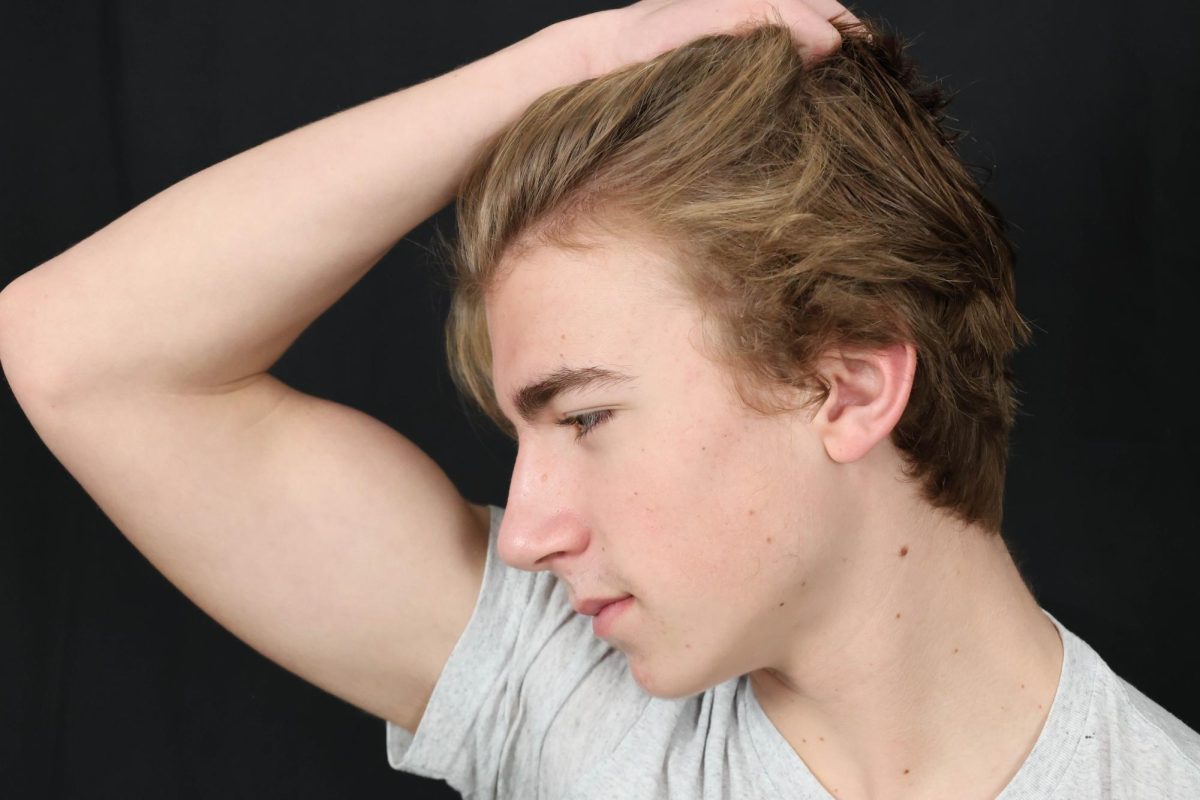
The first time that he remembers having his current hairstyle was in seventh grade, when he took a shower and then donned a beanie to help it dry. When he took the beanie off, his middle part was there, and he just rolled with it.
“Suddenly the middle part appeared,” Dickson said. “It feels good. I think it matches my face shape. It’s easy to keep clean. I think it looks good. And it makes me feel happy.”
Dickson’s parents have taken a hands-off approach when it comes to his hair; however, his mother knows how to cut hair, which has been a great resource for him when he has gotten a bad haircut in the past.
“Sometimes I’ll go and get a bad haircut, and then I’ll be like, hey, can you fix this part?” Dickson said.
His hair before his current middle part was not dissimilar to it, having either a messy side part or bangs. During this phase, despite the messiness of his hair, he would always have the reflex to push it out of his face.
“My hair didn’t really part in any particular way, but I would pretend I had a side part. So I would kind of try to comb it over, which didn’t work,” Dickson said. “I still have the habit of when I would push my hair out of my face. And, you know, that might translate well to the middle part today.”
Dickson’s hair impacts him a lot in the morning, when he takes a shower, which does take time in his morning routine, and slicks it back to create his middle part.
“The way I get the flow is I have my hair dried back on my head, and then I just press it forward so that it looks like my regular hair. But the slickback has become a bit of a joke with a few of my peers, and it looks absolutely ridiculous, and also it freezes to my scalp when it’s cold,” Dickson said. “If I don’t wash it every day, it looks nasty. So it is a bit of an upkeep.”
For Dickson, keeping his hair nice by washing it every day is essential to better physical and emotional health.
“When my hair is clean and well-kept and flowy, how I like it to be, I feel good,” Dickson said. “When my hair feels nice, I feel nice.”
Eva Edwards
For Eva Edwards, hair has never been just hair. From bold childhood choices to a more refined look today, Edwards’ hair journey mirrors the evolution of her personal identity.
Edwards currently keeps her hairstyle simple and controlled. She gets it trimmed regularly and styles it with a blow dryer and round brush, opting for a smooth finish over her naturally curly hair.
“When I do my hair, and then it rains, and my hair’s naturally wavy, so it gets all frizzy,” Edwards says.
Edwards describes her hair history as “pretty darn crazy,” recalling a series of funky hairstyles.
“I’ve had some wild cuts and wild colors in my hair,” Edwards says, “I had like totally different funky hair. I had rainbow all underneath my hair. Like an undercut but with dye.”
Eventually, she landed on a shade and style that feels authentic.
“I think I found a good natural color,” Edwards says. “It fits who I am currently,”
Though Edwards doesn’t dislike her natural curls, they aren’t her preference.
“I don’t like how I have to force it,” Edwards says. “I can’t really get each curl to look the same, which really bothers me.”
She’s also noticed how outside validation has influenced her styling choices. Compliments tend to come when her hair is blown out and straight, not when it’s worn naturally.
“I guess I just do my hair a lot more now,” Edwards said. Despite this, Edwards is clear that her hair does not define her, but it is a big part of her identity.
Her first major hair change happened early. Around six or seven years old, she cut it short and added bangs. Since then, she’s relied on trusted salons like Aveda, valuing consistency and reliability.
Edwards’ relationship with her hair is ongoing, shaped by experimentation, perception, and self-discovery. In the end, it’s not about perfection, but about finding a style that feels like home.