
My dad loves to read. When I don’t know what to read next, I ask him, and given that we have similar personalities (he is my dad, after all), I normally enjoy the books that he recommends to me. However, this suggestion of his surprisingly bit the dust.
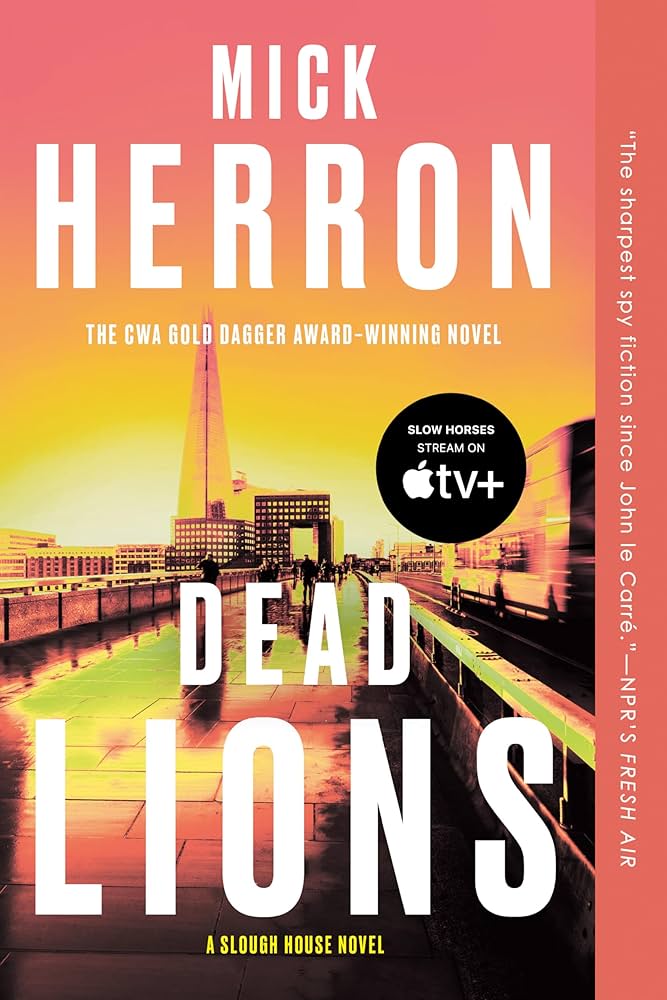
“Dead Lions” by Mick Herron is the second novel in his “Slough House” series. It is about MI5 spies who have made some sort of big mistake in an operation, then were disgraced and sent to Slough House. Every book in this series is told from multiple points of view, emphasizing the ensemble nature of the story. The author, Mick Herron, is famously known for writing the “Slough House” series, having first written “Slow Horses” in 2010. After the London bombings on July 7, 2005, Herron was inspired to write about MI5, the United Kingdom’s domestic counter-intelligence and security agency. He first worked as a subeditor for a journal about employment law, but after the series’ success, he was able to move into writing full-time.
This semester, I took Popular Literature for my ELA course, where we could choose our own books to read for the class. The first book I chose was “Dead Lions.” For the first couple of weeks of this class, I was reading this book in hopes of it finally coming good. It didn’t. I kept on reading, and it rewarded me with characters and storytelling that did not fit my interests.
The two new characters in this book, Shirley Dander and Marcus Longridge, are quite vanilla, and their somewhat romantic subplot lacks any fire, especially when compared to the high-quality romance of Min Harper and Louisa Guy. Harper and Guy’s relationship is one of the more interesting aspects of this book, drawing readers into both their messy lives and the ways their romance helps them and makes their mundane work at Slough House more interesting.
Another bright spot is Slough House boss Jackson Lamb. Lamb’s personality is spiteful, but he remains knowledgeable and powerful from past operations, particularly those during the Cold War. Lamb is first seen in this series as a fat old man who spends his days ordering his subordinates at Slough House to do meaningless tasks. As the first book progresses, you begin to learn about how competent he actually is, with his espionage and martial arts skills taking center stage. His spunky personality also adds to his oddball charm, with his snarky humor and subtle competence showing just how individualistic and fleshed-out he is as a character.
As we’ve seen, the characters here are hit-or-miss. Despite the likes of Lamb, as well as Harper and Guy’s relationship, the rest of the characters are just not interesting enough to justify reading the whole book. River Cartwright, another member of the Slough House ensemble, had a wonderful character arc in the first book. At the start, he was a promising agent but was betrayed by his ambitious colleague James “Spider” Webb. Over the course of the first book, he was very disappointed to end up in Slough House, but he proved himself and found that it wasn’t as unbearable as it seemed during their operation to take down a terrorist group.
Another thing that the first book did better was the action and the overall plot. For the first third of “Dead Lions,” I found myself stuck in a pace that did not suit me. The exposition lasted way too long for my liking, and some points of view were far less exciting than others. The mystery of this book — centered on who murdered a Cold-War era spy — was far less my reading style than that of “Slow Horses,” which was about taking down a white nationalist group. While reading “Slow Horses,” I was excited from front to back with how much more exciting the plot was than its sequel.
Therefore, I give this book two and a half stars. It wasn’t horrible by any means, but it didn’t really fit me. I also didn’t feel a connection in the way that I have with other books.
I didn’t even finish this book. There were better books to read for me, and I wanted to spend my valuable time in class reading books that I would enjoy. Don’t get me wrong, this is a great book and series for a different demographic of reader, just not me. The pacing, characters and premise were not as exciting as the first book, with the book’s appeal being to readers that prefer a slower pace and appreciate British culture more. In 30 years, maybe I’ll rediscover it and love it. Just not today.