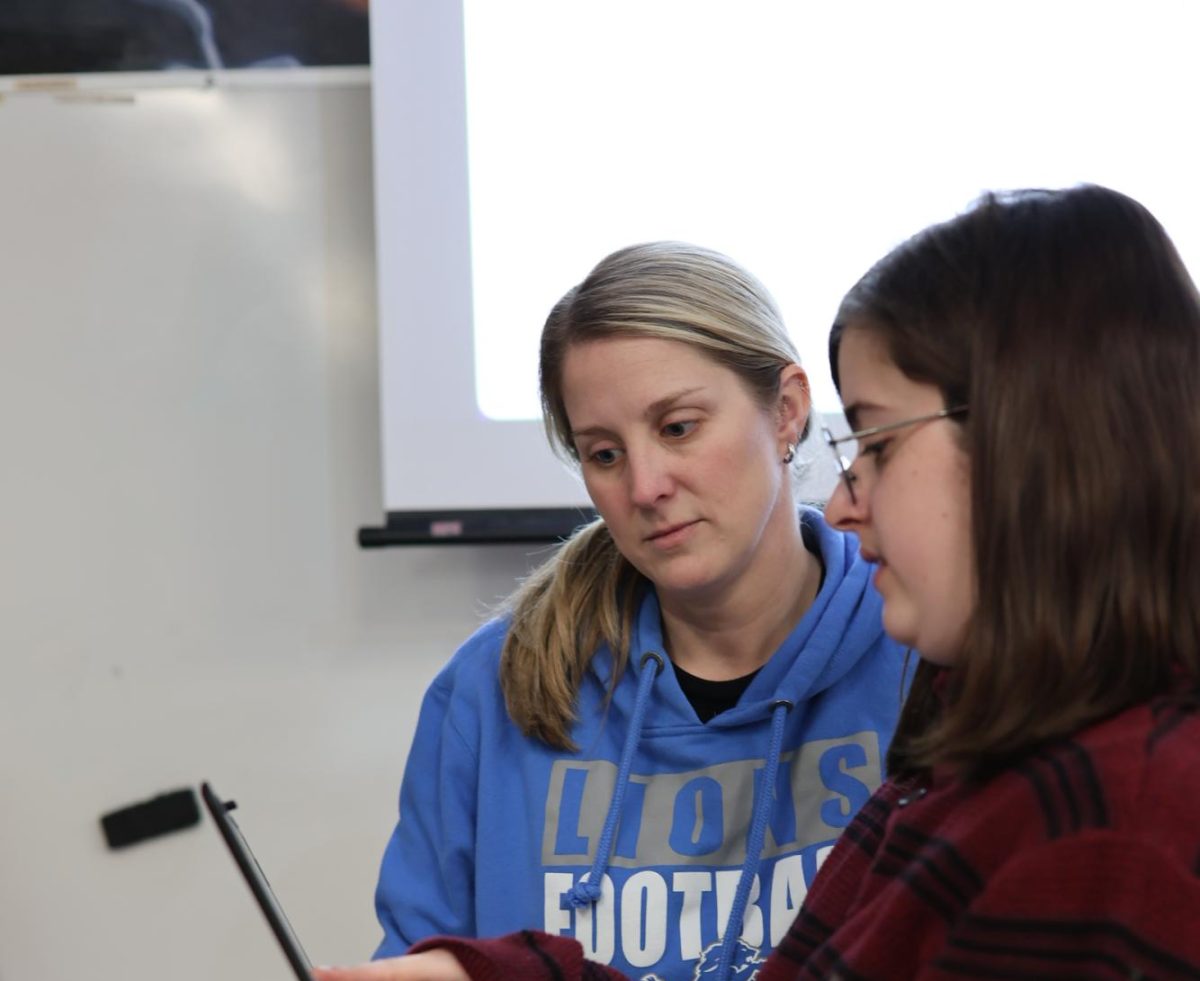
Michelle Yager says that she was “predestined” to become a teacher.
Yager comes from a long line of teachers, so in elementary school, that’s all she didn’t want to be. She said she “fought it for a long time,” but eventually she came to terms with the fact that it was meant to be.
When Yager graduated college in 2009, the financial crisis hit and her dreams of going into a profession related to design and advertising were washed away; no jobs were open. She then went to work at the Hollister at Briarwood. Even though it’s so far off from teaching, Yager was eventually promoted to store manager. Then, she had a realization.
“I was working with high school kids, and I was like, ‘I don’t want to fire kids; I want to work with them to make them better,’” Yager said. “And I was like, ‘Dang it. Okay, I think I’m a teacher.’”
After working at the mall for 4 years, Yager began to teach English to high school students. After 5 years, she switched to teaching math. At the next school she taught at in Ypsilanti, the timeline lined up with COVID-19. Yager found that a challenge teaching online school during this time block was that many students needed accommodations, and it was hard for her to help everyone.
Some time into her career at this school, Yager saw a post on Facebook from former CHS history teacher Sarah Hechler about job openings for math teachers at CHS.
“I grew up in Ann Arbor; I went to Huron,” Yager said. “I just never felt like I was at that caliber that my teachers were at, so I had never considered it.”
Ever since Yager has been hired at CHS, she has loved the support that she’s gotten, especially from her colleagues. She feels more seen, and she feels that the content and lessons she can give are more flexible to fit herself and her specific class’s needs.
“It’s the most cohesive unit I’ve been in, the most supported, the most seen,” Yager said. “I felt like since day one my voice has been heard, like what I thought was important to our students specifically. It emboldens me to try new things.”
She also has gradually over time made the switch to teaching math, and she thinks it’s because she likes that math is more precise.
“I think I lost my spark for English because you can’t teach creativity,” Yager said. “You can have uncapitalized Is for days, but if you have an exponent instead of a linear expression. That changes everything.”
Yager loves teaching math because she gets to witness students experience “aha moments” all the time—the moment a concept or a problem clicks in their brain.
 “It’s always fun to see kids who didn’t understand something first semester,” Yager said. “All of a sudden they get it, and it’s just this light in their eyes that you’re like, ‘Yes! I was a part of that; I helped!’”
Yager sometimes teaches Math Support, in which 2 years ago she helped a student with a math project, a moment she still remembers and holds dearly to her heart. They were trying to draw a picture with functions to replicate a photo the student had taken herself. Something kept getting messed up with their functions; a cosine or an exponent was placed in the wrong spot. Finally, the graph lined up exactly with the photo.
“Both of us go, ‘Yes!’ It was so loud; it was massive,” Yager said. “It was supposed to be quiet, and kids were working, and we were screaming and excited about math. It was so dorky, but at the same time so gratifying.”
This ties into a philosophy that Yager believes in: effort times perseverance equals grit. In her Algebra one class, she notices that a lot of the time, students expect different results while using the same strategy. She also adds that if it doesn’t matter to the person solving the problem, it won’t stick with them; this is effort.
Yager also thinks that the way to help students through learning math is by providing answer keys and having students see the right way to complete their work. That’s why she asks students to not erase any of their mistakes.
“[Answer keys] help break down my thoughts, making the steps visible,” Yager said. “It’s analyzing their work, not staying in the wrong, because that’s the point; to get better immediately.”
At CHS, Yager feels that the first-name basis for all teachers helps make an impact on students in good ways and bad ways. She feels as though it’s hard to balance the relationship of whether or not teachers are friends with students, even though they care about them and their progress. However, she thinks a big positive is that students generally feel more comfortable asking questions. She says that “Mrs. Yager” does not sound as supportive as a first name.
Being a teacher is something that Yager is proud of. She doesn’t regret her decision to go down the education path, and she’s glad she ended up in her current role as a math teacher at CHS. Helping students is something that brightens her day.