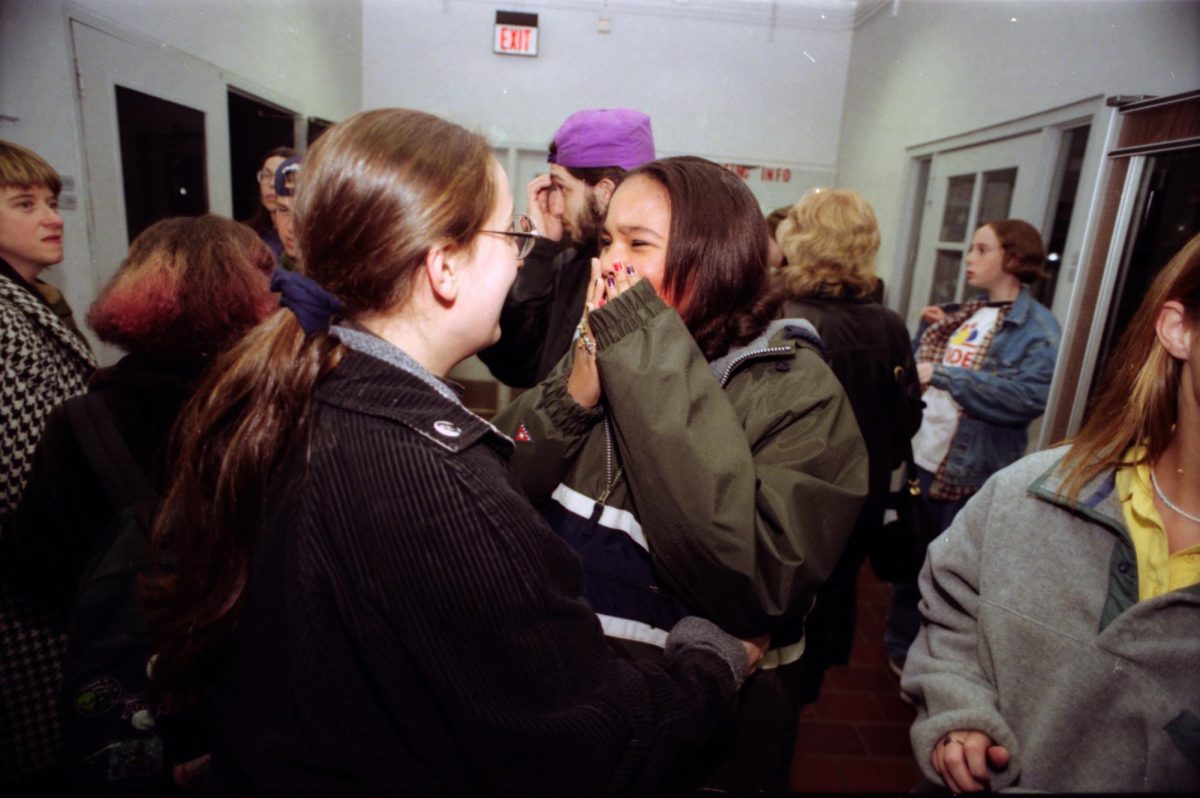
In 1997, an emotional Cassie Haynes stood outside the Craft Theater, bringing her hands to her face in disbelief, as she found out she’d been accepted into Community High School.
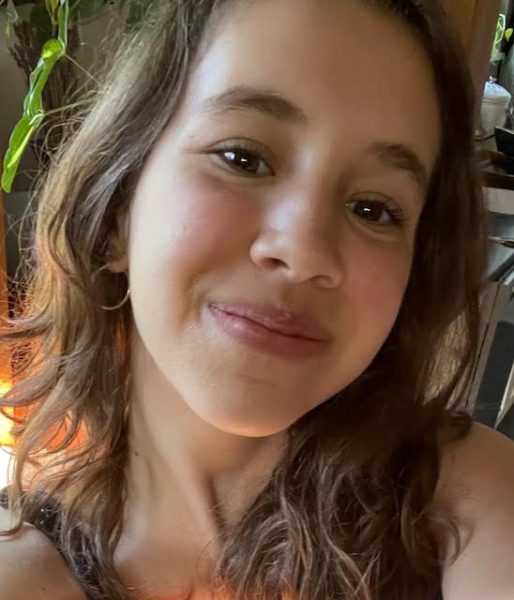
Fast forward nearly 30 years. Since Haynes’s graduation, she’s received her law degree, founded a nonprofit newsroom and become a journalism strategist. Many of the values she developed at Community, Haynes thinks, prepared her for the adventures ahead.
“You’re celebrated for being weird, for going against the grain,” Haynes said. “I think that set a lot of us up really well in adulthood for being authentic to ourselves.”
For all four years of Haynes’s time at Community, she was active in theater, participating in shows like “The Wiz” and “The Birds.” She also participated in a past program at CHS called SEED, which stood for “Students Educating Each Other About Discrimination.” As a high schooler, she would work with middle schoolers to teach them about inequality.
With AAPS sixth graders, Haynes defined words like “prejudice” and “bias” and played games that focused on cooperation and critical thinking.
“We would get into a game that usually challenged students in some way to look at their own experiences and identities through a new lens,” Haynes said, “ideally enabling them to build a different understanding of stereotypes and discrimination.”
Some of Haynes’s closest friends today are people she met at Community. She recently had coffee with her old English and creative writing teacher and finds it a joy to still be connected to people from high school in her adulthood.
During her years at Community, Haynes felt confident she would become a Broadway star. Determined to pursue her dream, she went to Pace University in New York and graduated with a Bachelor of Fine Arts in Theater in 2005.
Haynes soon realized that making a living as an actress in New York would be nearly impossible for her. Two years later, in 2007, she began law school at Northeastern while also completing a master’s degree in public health at Tufts University.
In the summer of 2008, after attending a lecture given by Michael Dukakis, the former governor of Massachusetts, Haynes sent Dukakis an email expressing her desire to work in grassroots politics. This led to an internship with the Democratic National Committee. Presidential elections were underway, and Haynes was fascinated by election law and political communications. Taking a chance by asking the former governor of Massachusetts proved valuable to Haynes.
“It taught me that all you have to do is ask,” Haynes said.
In 2017, Haynes began working in Philadelphia as the deputy executive director of the city’s anti-poverty agency. However, she felt that there was a value misalignment.
“It was like running face-first into a brick wall every single day,” Haynes said. “There was so much bureaucracy.”
She began imagining how she could more directly change the lives of her neighbors.
“The reason I wanted to take that job was because I cared deeply about my neighbors and my community, and the reason I left that job was because I care deeply about my community,” Haynes said. “And I didn’t feel like I could make a change from that role.”
After her departure, Haynes co-founded the nonprofit journalism organization Resolve Philly in 2018 on the premise that everybody deserves access to accurate, authentic and representative news and information. Resolve Philly produces journalism that serves communities through local reporting. Combining her interest in election law and public communication, Haynes created an organization that not only provides unfettered access to news and information but also bridges the gap between journalists and marginalized communities.
A year after Haynes’s father died in 2021, she and her wife moved back to Ann Arbor to live near Haynes’s mother. Until 2023, Haynes continued to work remotely for Resolve Philly, flying to Philadelphia every other week to attend meetings and teach a class on policy communications at the University of Pennsylvania.
In 2024, Haynes was awarded a Knight-Wallace fellowship at the University of Michigan, which brings accomplished journalists together for an academic year of study and collaboration at the University of Michigan. With the fellowship, journalists are encouraged to pursue their own projects. Haynes focused on researching how reporting impacts the evolution of social narratives.
“I have always known and understood the importance of a free press, but the relationships I built in the fellowship and our experience traveling to Croatia, Bosnia and Serbia, where conflict is fresh and democracy is a sham, really enabled me to internalize just how critical a free press is to a functioning democracy,” Haynes said.
Today, Haynes works with newsrooms across the country on building their organizational and revenue strategy to create narratives that help them better connect with their audiences. She also works with funders to help structure their grant-making programs for journalists and newsrooms.
Haynes is proud of her ability to support the missions of many nonprofits, many of which align with some of her identities.
“I am a black queer woman,” Haynes said. “And I think in a lot of ways, in some of the spaces that I was in with Resolve [Philly] and with the city of Philadelphia, just walking into a room with knuckle tattoos and my brown skin was a political statement. Having the jobs that I have had has been a political statement.”
Haynes has worked with multiple nonprofits since she left Resolve Philly: one organization reports on gun violence and effective interventions to combat it; another serves primarily Black, brown and immigrant communities in Chicago to help them get the information they need. A recent project, anchored in Philadelphia, where Haynes will be the executive director, focuses on stewarding public scholarship by preserving, contextualizing and sharing U.S. history with care and rigor.
“It’s really difficult to look at what’s going on around us right now in 2026 and understand it and focus on solutions if we don’t understand our history,” Haynes said.
Looking forward, Haynes’s career aspirations involve finding opportunities that challenge her to be creative as a leader. She loves building businesses, operating structures and formulating governance models.
“I still don’t know what I want to be when I grow up,” Haynes said. “Putting one foot in front of the other feels like a gift.”
If she were going to offer advice to students at Community right now, it would be to treat one another with kindness and to keep building relationships. She believes you’re never too young to be doing that.
“None of my teachers ever told me that my feelings, my opinions, my experiences, were not valid,” Haynes said. “I have always been somebody who will challenge power structures. I will stick true to the values that I hold.”
How that work in the coming years takes shape for Haynes remains to be seen. What is likely, however, is that Haynes will approach it with the same enthusiasm that she displayed outside the Craft Theater nearly three decades ago.