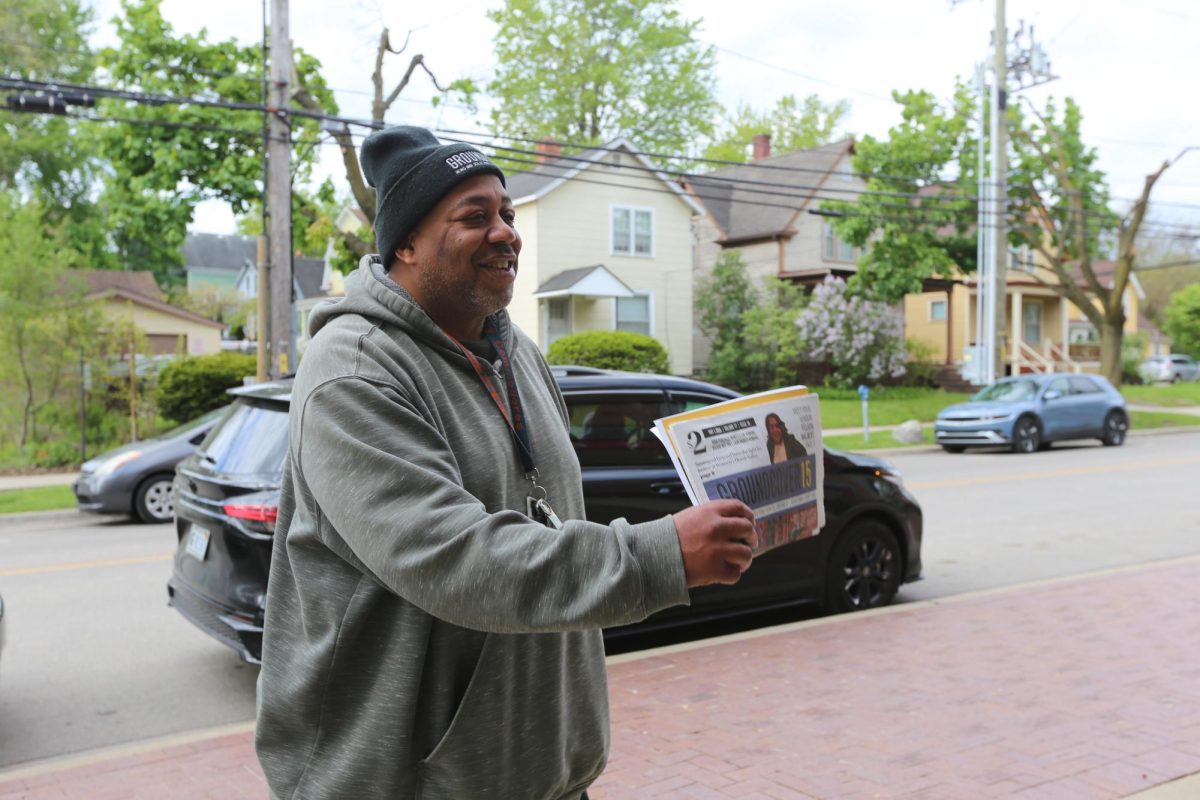
Choruses of “Hey, what’s up man? How you doing, brother?” brighten the dimly-lit lobby of Ann Arbor’s YMCA. Sitting on a bench in the corner of the room, Mike Jones flips through a stack of “Groundcover News” newspapers when he isn’t giving out fist-bumps and waves.
When I entered the YMCA on a rainy Wednesday morning in late April, Jones gestured me over, extending his hand in greeting. Right away, he proudly introduced himself as a Groundcover vendor, writer and board member.
“Wherever there’s a free society, there’s a street newspaper,” Jones said. “Journalism and free press are the heartbeat of democracy. Without this,” he said, gesturing to the stack of Groundcovers beside him on the bench, “there’s no democracy.”
Founded in 2010, Groundcover News has served as a way to provide employment for people impacted by poverty and to empower low-income individuals to document the stories of underrepresented groups in Washtenaw County.
“We’re trying to bring life to homelessness and poverty and real issues within our community and on local and global scales as well,” Jones said.
Walking through Ann Arbor, people might spot vendors proudly sporting their special-edition Groundcover 15th Anniversary shirts, possibly outside of Literati Bookstore, Sweetwaters Cafe or Zingermans’ Deli.
Lindsay Calka first became connected with Groundcover as a customer, when she regularly bought papers from a vendor outside her University of Michigan class. Eventually, she began volunteering with the organization, spending time in the newsroom office and getting to know the people who worked there.
“Since I moved to this community, Groundcover has been the anchor of my roots here,” Calka said. “My Groundcover family are the people that have known me that whole time. Roommates have come and gone, I’ve had different jobs, different friends and relationships, but Groundcover has always been there.”
In the summer of 2020, Calka took over as the managing director and publisher of Groundcover.
Oftentimes, Calka explained, social service organizations will support people impacted by poverty by offering them gift cards or vouchers. Instead, Groundcover provides economic autonomy, which allows people to take more control over their lives and provide a sense of stability.
Groundcover offers a rare opportunity for people from disadvantaged backgrounds to get paid for their creativity and self-expression.
“The things that can make people connected to their own humanity and identity aren’t going to be accessed through a voucher or a gift card,” Calka said. “People know what they need, and if they have the resources to access that, they’re going to be better off.”
Groundcover pursues first-person perspectives and narratives in its writing and coverage of social issues. Take, for example, a story about an overcrowded homeless shelter.
“Your average paper is going to go to the director or the manager of that shelter and ask them for a quote,” Calka said. “Something like ‘What is the reason this shelter is like this,’ and instead, Groundcover goes to the people that are sheltering there and asks them ‘What is your experience with this, what do you think could be the solution.’ It’s a simple change, but it makes a really big difference in how narratives about social issues are perpetuated in our media and in our popular consciousness. We value the perspectives and ideas of people most impacted by the things we’re writing about.”
Jones contributes articles to every Groundcover publication. Serving as a full-time vendor, he sells papers for two to four hours every day. Most frequently, he is stationed outside the Ann Arbor YMCA and the Ypsilanti Food Co-op, places where he feels known and supported.
“They understand the purpose of the paper to bring awareness to homelessness, poverty and social justice,” Jones said.
On the University of Michigan campus, he has less luck selling papers. Students rush by him without a glance, phones in hand and eyes down.
“When there’s a herd of people, people just keep trying to follow the herd,” Jones said.
Groundcover provides an invitation to connect with people you don’t know and an opportunity to challenge your assumptions. While the majority of Groundcover vendors are not actively experiencing homelessness, most have faced it at some point in their lives.
“I know this has an impact on people’s understanding of what homelessness is, how it works, who it impacts and the causes and consequences of the failing of our society to let homelessness be as prevalent as it is,” Calka said.
To produce his best work for Groundcover, Jones pays attention to global news and attends city council meetings. In his self-published book, “Where Is the Outrage?,” a collection of essays, he discusses how national issues like voting rights, racial inequality and housing discrimination impact us here in Ann Arbor.
“What I’ve learned as a writer and as a journalist is how things that have happened globally actually really do affect us locally,” Jones said. “It transcends from global, national and then right to our dinner table. I tend to write from that scale.”
Jones’s favorite essay in his book is called “The Gentrification of Ann Arbor, Michigan Through The Eyes of Mike Jones.” In his piece, he discusses the declining black population in Ann Arbor since his childhood. According to MLive, historically Black areas like Kerrytown, Water Hill and the Old Fourth Ward have dropped from Black people making up 45% of the total population in 1970 to 8% in 2020.
In the early 2000s, new trendy businesses like Starbucks replaced places that were a central part of the Black community in Ann Arbor, contributing to the shifting socioeconomics of the city.
“I grew up right around the corner, so I’m a historian when it comes to Ann Arbor,” Jones said. (In his book, he mentions his former house on Ashley Street.)
Groundcover provides opportunities for its writers and vendors to develop their skills and connect with the community.
As part of a recent journalism initiative organized by Groundcover, Jones was mentored by Joe White, a former Wall Street Journal editor. Inspired, Jones has been considering starting his own journalism mentorship program for high school students.
Every November, in an effort to honor Homelessness and Hunger Awareness Week, Groundcover hosts an open mic night at rotating venues. The night serves as a chance for vendors and volunteers to showcase their talents and personalities.
“There’s all these awesome other aspects to who people are that can’t be translated through the paper,” Calka said. “The open mic is this chance for people to get to know others, to hear their voices, their personalities.”
Jones has always had a love for music. He posts his music on Spotify under the name Get Cha Mind Right Crew. His music draws inspiration from some of his lifelong favorites: Bob Marley, Tupac and 90s New York underground rap.
When Groundcover starts its own radio show this summer on WCBN, a University of Michigan student-run radio station, Jones will be one of the hosts.
Calka hopes that it becomes routine for a greater number of Ann Arborites to buy Groundcover newspapers.
“They expect to see the vendors, they expect to buy the paper, they know it comes out every two weeks and they see it as a valuable voice and contribution to news and our understanding of social issues,” Calka said.
Jones was once selling papers outside the downtown Ann Arbor District Library when a mother with her two kids approached him. She pulled out two dollars to buy the paper and handed it to her daughter to give to Jones. The younger brother looked upset.
“I said, ‘Do you want a paper?” Jones said. “I gave it to him for free, and he was just so happy. I always tell that story because it really hit home for me.”
Near the end of my meeting with Jones, the rain had begun to clear. “I’m going to interview you now,” Jones said, proceeding to quiz me on my future journalism plans. As we talked, the sound of feet rushing up the stairs and frequent elevator dings marked the beginning of the morning rush hour at the YMCA. Down the street, construction drilled on, marking another chapter in ever-changing Ann Arbor.
“Who should tell the story of the city?” Jones said, repeating the question I’d asked him. He flashed a quick smile. “That’d be me.”