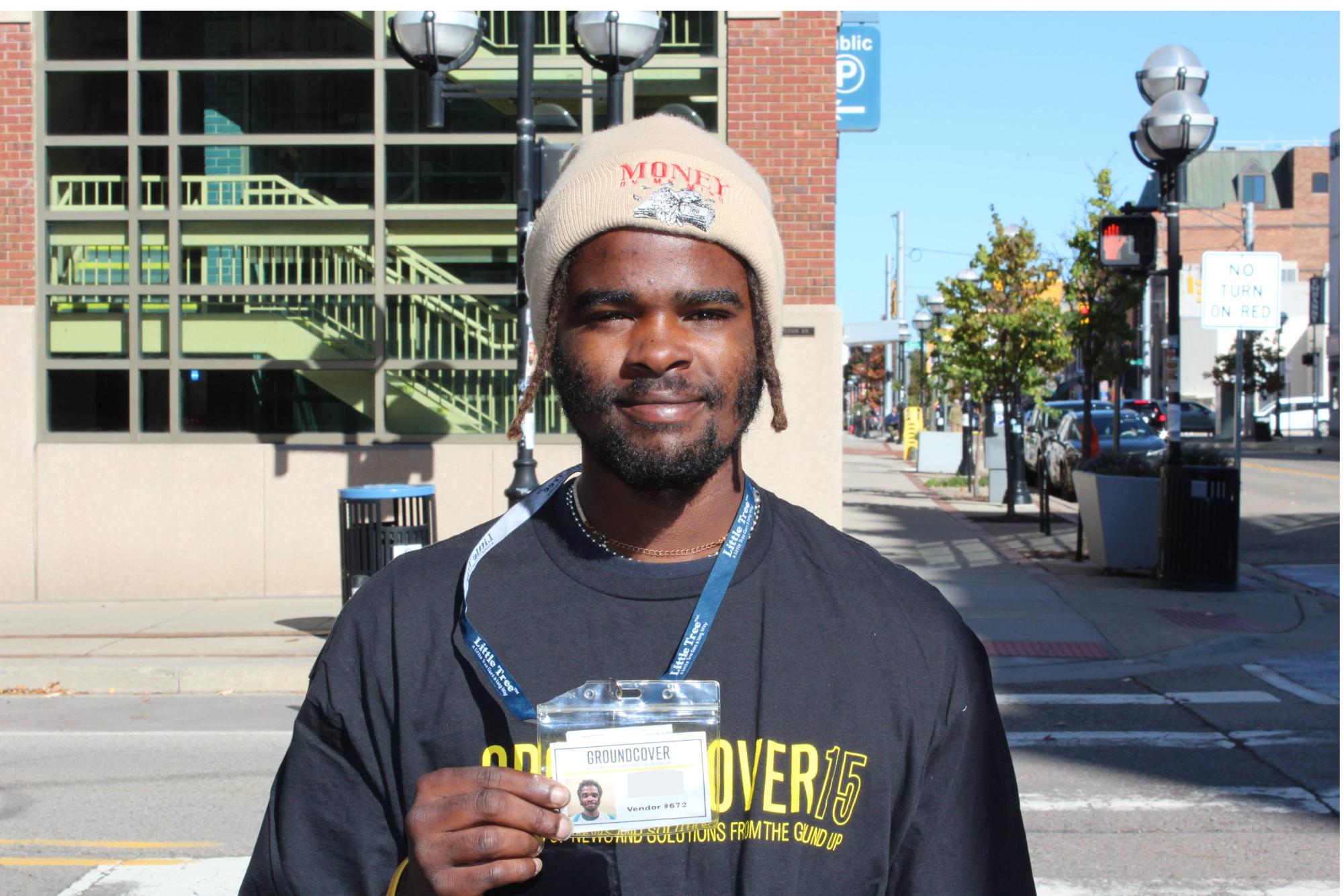
Groundcover News vendor Em stands on the corner of Fourth Ave and Washington Street outside of Literati Bookstore, trying to sell papers to the midday crowd. Em has lived in Ann Arbor for a few months and has been selling Groundcover during that time.
“I don’t stay around in the same place for too long,” Em said. “But I’m trying to get a steady and comfortable place again.”
People are facing housing insecurity in Ann Arbor, and it is visible on the street corners downtown. Dan Kelly, a former executive director for the Delonis Center, believes housing insecurity much more common than people realize. The Delonis Center is a local shelter that provides housing, although it often has long wait lists . The center does provide emergency services and a wide array of basic needs and resources, like access to showers, laundry, phones, storage, computers and other contacts to other agencies in town that can help with employment, job readiness or mental health, according to Kelly.
Delonis center specifically serves individuals without kids, while other agencies serve families in need of housing. In addition to the 50 standard beds it provides, there is temporary housing in the winter months available at the Delonis Center.
Through the two housing options the shelter assists — constant and temporary — they make it their mission to support everyone who comes through the door.

Another support is an organization that has been around for a while and was started by The Zingerman’s Deli, a business located right next to CHS. Zingerman’s Deli began Food Gatherers in 1988, Michigan’s first food rescue program. Food Gatherers is an organization that brings food to people at risk of housing insecurity. It has grown into an independent, tax-exempt non-profit.
In the fiscal year of 2024, Food Gatherers distributed 8.5 million meals through received goods. They distributes food to centers that keep a will serve it to those in need; one of those places is the Delonis Center, and another is St. Andrews Church.
Hannah Crabtree, CHS art teacher, along with Tracy Anderson, CHS journalism teacher, lead the student connection to the St. Andrews Free Breakfast Program, allowing students to volunteer to serve food before the school day starts. The St. Andrews Breakfast Program operates out of the basement of St. Andrews Church across the street from the Community.
The idea to engage students emerged from a discussion a year ago between Anderson and Crabtree, and they reached out to St. Andrews soup kitchen to see what student volunteer opportunities they had. The two hoped students would volunteer so they could see the impact they have on the community. The relationship between CHS and the Breakfast Program has evolved into student volunteers helping several mornings a week.
CHS also participates in a fundraiser every year: forums compete to raise money for Food Gatherers.
“There’s a level of abstraction with the fundraiser,” Crabtree said.
Each year, students find creative ways to raise money, whether that’s bake sales, going door-to-door to ask for donations or selling handmade goods. Crabtree feels that the human component of volunteering, along with the school’s competitive fundraiser for Food Gatherers, helped students become active in the competition.
Beyond food insecurity, however, many members of the community also face challenges with housing.
“Housing insecurity hits all sorts of folks,” Mayor Christopher Taylor said. “There is a lot of family housing, single-person and child housing insecurity [that] exists”
With food and housing insecurity in Ann Arbor, there’s not one solution. Instead, there are many support systems available. Temporary housing, like the Delonis Center, or significantly discounted housing are examples of a safety net for those facing financial insecurity. They then have the opportunity to transition into more permanent housing: an apartment, a sublease or occasionally a house.
Some organizations are working to solve the problem before it even appears. For someone facing housing insecurity, even before they lose their residence, can reach out for help and sometimes avoid becoming houseless. It all starts by calling a number — 221 — for housing access in Washtenaw County.
“Anybody having a housing crisis, they’re asked to call that number early so they can try to get some help early on to stop the eviction in the first place,” Kelly said.
If that does not succeed, there are temporary housing in the winter through a rotating shelter that moves between churches around Ann Arbor. The rotating shelter is for a group of up to 25 clean and sober men, who also have to be mentally healthy.
“It’s for the quieter, gentler crowd,” said Sue Nishi, who works with the St. Andrews Breakfast Program. “It’s nice because it gets them out of the crowded situation, and there is more of a homey vibe to it.”
From there, many strive to find a solution that is more reliable and permanent.
When groups that supply housing think of more stable solutions, the city and state governments often get become. Ann Arbor has been working to support this population through sequential policies and proposals. In November 2020, the city passed Proposal C, which funded the maintenance of housing and building or purchasing new affordable housing, which is then held for someone under the market value. The proposal passed with a 73% “yes” from the voters, and all Ann Arbor precincts voted in favor. This indicates Ann Arbor residents are willing to try to improve affordable housing.
“[We are looking] to have about a thousand units of city-owned, city-built affordable housing online over the next couple of years,” Mayor Taylor said.
The support for those facing housing insecurity continues to grow and help more people. And while there is more work to be done, there are moments of tremendous success. A guest who frequented St. Andrews Breakfast Program moved into a group home recently, highlighting an exciting individual success.
“There are enough social services that helped him and got him what he needed,” Nishi said.
Another success story Nishi witnessed was a woman received food from St. Andrews’ Breakfast Program for some time. She was able to find a job and an apartment.
The broader community has a massive impact on the population facing housing insecurity, and it is a collective effort to support this population and help them succeed
Even though Em has experienced tough situations, moving from place to place and dealing with past addiction, he remains hopeful and is ready to take charge of his life.
“I have a bigger picture of what I want to achieve,” Em said.