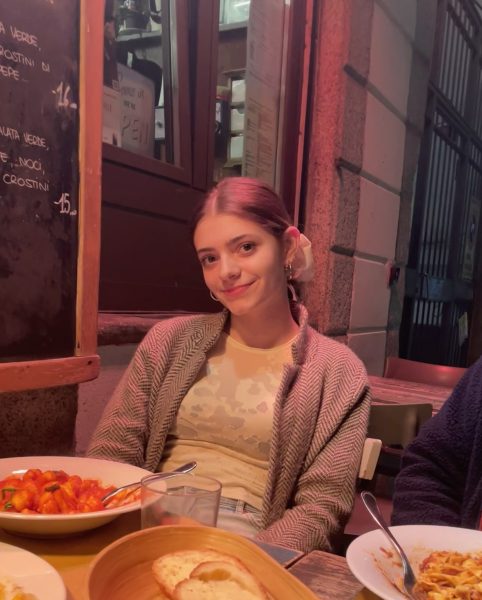
Ellena Biermann
Ellena Biermann did not step into boxing expecting to stay. After spending seven years in taekwondo, she was already used to being in a male-dominated environment, but boxing felt different.
“I took one class and fell in love with boxing,” Biermann said. “I started private training very soon after I had started, and my coach is the reason I stuck with it.”
Biermann’s coach’s story is very inspiring, and her unwillingness to give up is what makes her such a good mentor. She has seen Biermann at both her lowest and highest moments, always supporting her without judgment or criticism.
For Biermann, walking into a boxing gym can be intimidating, especially as a girl in a space that is often defined by stereotypes.
“There are a lot of stereotypes surrounding women who box, that they are not super nice people, and that you have to fight to do boxing as a sport,” Biermann said.
Biermann mostly spars, which includes controlled practice fights where she works on technique, timing, footwork and combinations with a partner. Sparring is different from boxing as it focuses on skill development and learning rather than officially competing to win.
Still, outside stereotypes and opinions follow Biermann. People question whether she was even good enough, something she believes would not happen as often if she were a boy.
Boxing taught Biermann more than how to throw a punch. It taught her discipline, confidence and how to push herself out of her comfort zone. Biermann’s proudest moment came from when she was outside her comfort zone: the first time she sparred in the ring.
“It’s a completely different feeling, and more exciting,” Biermann said. “It was the turning point in my confidence as an athlete.”
Over time, boxing reshaped how Biermann sees herself. She believes everyone has an opinion, but that doesn’t need to affect her. She learned to rely on her training and abilities rather than outside doubt, focusing on what she is capable of instead of what others question.
For Biermann, strength also means using her sport to help others. Though volunteering with the Rocky Steady Boxing program for people with Parkinson’s Disease, she has seen resiliency in its purest form.
“You should never define a sport by gender,” Biermann said, “Nor depict yourself as weak because you are a girl.”
Some of the strongest and kindest people Biermann knows are women in boxing. In a world where women and girls face real dangers, she believes learning self-defense is not about aggression, but about confidence and the ability to protect oneself.
Amber Wagner
Amber Wagner’s path to the Army began with a personality test. In high school, the results labeled her as highly Type A — a personality type known for being competitive, driven, highly organized and motivated to achieve ambitious goals — shared by only a small percentage of the population, yet common in the military.
“It made me think that the military would be a good fit for me,” Wagner said. “By college, I had only done Air Force Reserve Officers’ Training Corps (ROTC), but I came from an Army family, so I knew I didn’t want to join the Air Force.”
It was when Wagner was in law school that everything clicked. After learning about the Army’s Judge Advocate General’s Corps (JAG Corps) and being accepted into a competitive internship, Wagner spent a summer at Fort Rucker, Alabama, becoming a JAG Attorney.
“After that summer,” Wagner said, “I fell in love with the Army.”
From 2011 to 2019, Wagner served on active duty, stepping into leadership roles traditionally held by men. She prosecuted cases, defending soldiers in court, fought the war in Afghanistan in 2013 and later worked directly with survivors of sexual assault as a Special Victims Counsel.
Along the way, Wagner faced gender discrimination, harassment and bullying from the men in positions of authority. Instead of staying silent, she relied on mentors who helped guide her through how to respond and stand up for herself.
“But really, the uniform is a great equalizer,” Wagner said. “As long as you are good at your job, that’s what matters.”
One of the hardest challenges that Wagner faced was not during war. In 2016, she had her son while stationed in Hawaii and has been a single mother ever since. Later, she moved from Hawaii to Texas with her seven-month-old while still breastfeeding, a moment she described as “harder than my Afghanistan deployment.” Balancing motherhood, leadership and military service required resilience that few talk about, yet according to Wagner, many women face.
Wagner’s most meaningful role was as Special Victims Counsel, where she walked alongside survivors during the hardest moments of their lives. Her career challenges the idea that leadership, strength and service in the military belong to men.
“Women are not just capable of filling these roles, but excelling in them,” Wagner said.
As of Feb. 6, 2026, Wagner will have reached 15 years of military service. She currently serves as the unit S-1/S-3 in her Legal Operations Detachment and holds the rank of O-4, Major, in the U.S. Army Reserves. Her career continues to reflect a commitment to leadership, service and breaking barriers for women in the military.
Amy Coyle
When Amy Coyle got passed a note during a consulting meeting, she didn’t expect it to be an offer to work at the CIA. She had been the director of Employee Assistance Programs for HCA Healthcare, but when she made the switch into the selective services, she worked as an employee counselor.
As time went on, Coyle began co-directing the agency’s alcohol recovery program. Around the same time, she began to climb the ladder of leadership within the organization. Along the way, she endured more adversity than she had expected.
Coyle worked on many programs, often building them herself. One in particular went on to impact the whole agency, yet her boss refused to nominate her for the agency-wide awards. He had her write her own nomination.
“When I went into the ceremony, I heard the announcer say that one nomination was from the office of security,” Coyle said. “Everyone laughed, even though they didn’t know my position, degrees or the training I’d developed. I walked out of the ceremony.”
As her time in the agency grew, she noticed that women were treated differently from men. The CIA’s first female director wasn’t elected until two years after Coyle retired, in 2019.
“Women were second-class citizens,” Coyle said. “I knew many successful female agents, but we had never even had a female director.”
Therefore, almost all of her bosses were men. One year, after almost nine months of pushing for an LGBTQ Committee, her boss tried to blame the lack of said committee on her.
“We had been at a meeting with the head of the agency, and my boss tried to put it on me that we hadn’t instated the committee yet,” Coyle said. “I had kept a file of every request and every response I got. I wasn’t going to let him blame me.”
After more than 12 years in the agency, Coyle retired in 2017. Her experience had shaped her as a person, and she was proud of her achievements and what she had built.
“I know I made a difference,” Coyle said. “I hope other women saw what I was doing. I hope I helped to inspire them.”