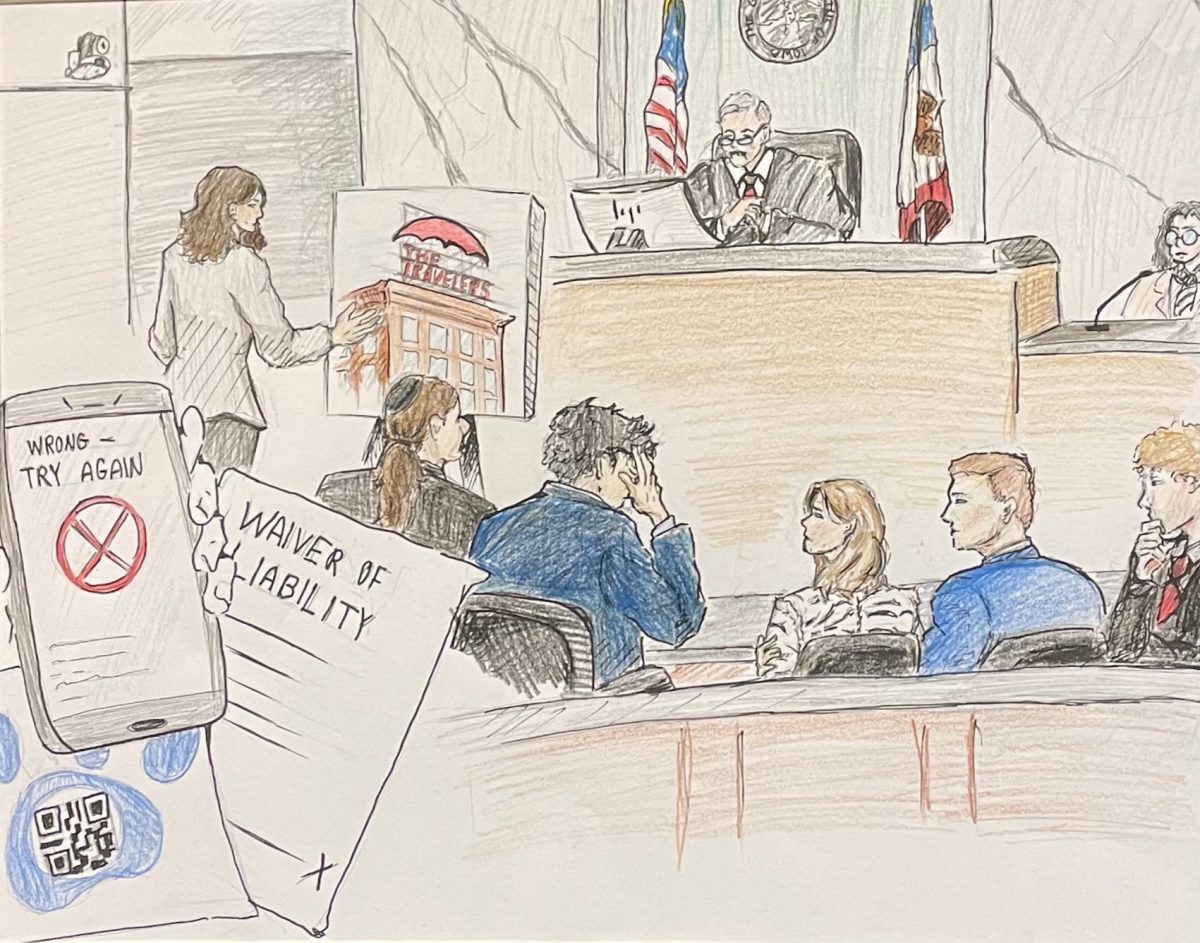
In January, Ann Arbor Public Schools (AAPS) teachers began working with an expired contract for the first time since 1994. Teachers now are working “to-the-rule,” or doing precisely what their contract states they have to do. According to the Ann Arbor Education Association (AAEA), the AAPS teachers union, they are working to contract to “raise awareness around the unpaid voluntary work that educators do before and after school, during our lunch and planning times, and on the weekends.”
But it’s not just the unpaid labor that is in dispute. At the school board meeting on May 6, Allison Echlin, a government and Indigenous Studies teacher at Huron High School who came to AAPS six years ago, reported that if she had stayed in her previous district, she would be making $23,000 more than she is in AAPS. The AAEA corroborates that point on instagram: “The MEA [Michigan Education Association] found an average of a $13,000+ wage gap between Ann Arbor teachers and comparable districts for the most experienced teachers.”
At the same May 6 meeting, Caroline Williams, a Huron High School math teacher, told the board that when she compared her 2024 salary to her 2025 salary she had undergone a 5.65% price cut from 2024 to 2025 because of the increase in the cost of healthcare premiums.
“My experience in AAPS has really only been that of financial duress and choices at the district level to put things under a lot of stress and a lot of services and teachers at risk,” said Adelaide Lancaster, a mom of three AAPS students who is involved in advocating for the teachers.
So why won’t the district just pay teachers cost of living raises, wages, and health care benefits that are competitive with neighboring districts?
For starters, AAPS doesn’t have an obvious source for the money. Currently, AAPS only has 5.7% in their fund balance. The fund balance, or the percentage of the budget that can’t be spent and has to be kept as reserve, must stay above the state-mandated 5% to keep Michigan’s state government from stepping in and taking control of AAPS. The state didn’t take control when AAPS dipped below that 5% a couple of years ago when it faced its $25 million deficit, but the threat of state control happening if the districts dips again is very real. Because they were concerned about that risk, the school board set a policy that the fund balance be at a minimum of 8%. Money that the district finds has to not only go to staff salaries, but also to rebuilding the fund balance. Yet Torchio Feaster, the president of the AAPS Board of Education, believes that both things can happen at the same time.
“It’s going to go up to a 9% by board policy next year,” Feaster said. “That’s our goal, that’s our hope. But obviously our priority is to take care of our staff and our teachers, so the board is going to be willing to pay teachers even if we’re not at the 8%. We’re going to take the raises we can take care of and then we’ll continue in the future, trying to get up to that 8%, 9%, 10% [fund balance]. But no, it’s not going to stop us from paying our teachers.”
So if AAPS doesn’t currently have the money for the fund balance or for teacher salaries, where are they going to get it? At the May 13 school board meeting, new AAPS Chief Financial Officer Anté Britten proposed three strategies for finding money: staff attrition, land and building sales, and school consolidations and program modifications. (Britten and AAPS Superintendent Jazz Parks did not respond to multiple interview requests for this article.)
AAPS’s main long-term strategy right now is attrition, when teachers leave the district or retire. The attrition process will take time though, and in the meantime the district is going to have to take more drastic measures and make several hard decisions, cutting spending in other places. A big complaint of parents and community members throughout this process has been that the district hasn’t been transparent with their budget, making possible spending cuts hard to see.
“Until the district is able to have clearer and more transparent financial reporting and help people better understand where the money is going, I’m not sure that we’e going to be able to get on a funding path that’s going to be sustainable for our district,” Lancaster said.
There are broad categories in the budget like “Software and License,” “Purchased Services” or “Supplies.” Community members are not sure what these descriptions mean, and yet large amounts of money are placed in those categories. John Benson, a financial expert and AAPS parent, thinks that there may be contract renewal rates in the budget that could add up to significant money.
The most transparent contract renewal rates in AAPS’s current budget are also the biggest in the budget: salaries and benefits. Teacher and staff salaries and benefits are 80% of expenditures. Benson hopes that as much contract detail can be shown about the smaller categories because renewal rates there add up to large amounts.
“The same reasons you want to know the contract renewal rates about your largest expense should be the same reasons that you want to know it for small expenses,” Benson said. “Start with enhancing reporting and aggregations of information and how that information is looked at over time. It would be welcome to everybody and help all the parties.”
Benson explained that salaries and benefits are only up 10% since 2019, but smaller contracts are up 50%. That is a significant increase, totalling about $20 million — which is the same dollar amount as the increase in salaries and benefits over the same time. Why would the small contracts increase by the same dollar amount as the largest expenditure?
“Salaries and Benefits are up 10% through strict management of renewals since 2019,” Benson said. “However it appears there’s less strict renewal reviews of smaller contracts…This needs to improve with transparency and strict reviews.”
Feaster’s attention has turned to eliminating program redundancies as one source of more money in AAPS’s budget. He suggests that is an area that could have a big budget impact.
“I think we have the detail necessary to find those redundancies and to eliminate them,” Feaster said. “I’m just leaving a meeting now with about 30 teachers, and they were telling us about the redundancies that they’re aware of and where they think we should make some corrections. So I think some of the redundancies are obvious, and I think that we can correct them.”
According to Feaster, for example, some redundancies come from the four comprehensive high schools not being on the same schedule, both because of their daily bell schedule and also because they vary between semesters and trimesters. Aligning schedules would allow more teachers to split their time between schools, reducing salary costs. Feaster also mentioned transportation as a resource that could be shared more effectively.
“We’ve got a bunch of different bus schedules that we might be able to do some consolidation with,” Feaster said.
District administration, however, says eliminating redundancies in the budget will not be enough to cover desired increases in the general fund balance and fair raises for teachers. For that, AAPS is going to need to make some more dramatic and disruptive choices: selling properties and consolidating schools. There are two categories of properties: non-student-facing land or buildings and school buildings. AAPS is overweight on both.
There are plots of land and administrative buildings that are at very low capacity or don’t get used that the district is holding onto until they get a fair market price offer. Feaster worries that people who would put an offer on the properties right now would try to take advantage of the district’s vulnerable position.
“There are a lot of true business people in this town, and people see something that is distressed, and right now they see our district as distressed, and there are people who I’m sure would like to take advantage of that and get under market value properties,” Feaster said. “And I don’t think the board is, at this time, willing to do that, but I am very optimistic that we’ll receive some fair marketplace offer in the future and be able to get some of those properties sold.”
In the meantime, the board will focus on a more significant but also a harder strategy: consolidating schools. Shrinking student numbers is a problem nationwide, and Ann Arbor Public Schools is experiencing that national trend. AAPS has been losing students every year, but its footprint hasn’t changed. Data presented at a board meeting on May 6 shows that AAPS comparably has more buildings than surrounding districts. AAPS has about 16,000 students and 32 school buildings. Surrounding districts with around the same number of students tend to have 21-23 buildings.
Whereas Britten estimates that land and building sales would net a one-time influx of $10 to 11 million, closing schools would free up as much as $1 million per year. That will make a big difference in the budget year after year, and contribute to some of the $6 million annual savings from program modifications that Britten anticipates.
Feaster knows that closing schools will take a lot of thought and care. Lancaster agrees that big change is going to have to happen, but is worried that the district won’t prioritize students during the process.
“I don’t think that we’re going about making those decisions in a way that is responsible to the future of our education system, and I don’t think it’s responsible to our students and families and teachers,” Lancaster said. “I think that we are looking at buildings and facilities and dollars and policies around fund balances, instead of what matters most to students and families.”
All of these possibilities in budget reduction are still just possibilities at this time, and the public won’t know more until the next board meeting on June 3rd. At that meeting, the school board will hear from district administrators about next year’s proposed budget, which has to be in place by June 30. The budget will be available for public comment on the AAPS website by May 28.
In the meantime, teachers’ compensation remains unsettled, with teachers being asked to make more concessions to account for AAPS budget shortfalls and to accept salaries that have yet to account for cost of living increases even as they cover more health care costs. Some teachers were hoping that the issue would be resolved by the end of the school year so they could attend activities such as field days, senior celebrations and graduations. But given that Feaster admits that the budget issues are too deep to get resolved by this coming fall, there is not currently an end in sight for the “work-to-rule.” Feaster does hope, however, to put a plan in place where teachers can get paid a fair amount starting the 27-28 school year.
“I don’t see that there’s any way that we’re going to be able to add money to the budget this year, to be able to have more money to pay teachers more this year,” Feaster said. “But the streamlining, the reduction of redundancies, the selling of property, all those things will go into next year’s budget. And the things that we can consolidate that have annual effect will go into the following year’s budget. So we’ll be able to free up money for decades, if we are able to make the right reductions — to be able to have more money, to be able to pay teachers what they deserve for generations going forward.”