“Dear Dad,
It’s 1:20 a.m., and the campers are finally asleep. I’m crouched on my top bunk, hunching between the rafters of the counselor room, writing by the glow of my fifth instructional YouTube video. My hand is cramping, I’m covered in sweat, and there’s ink all over the sheets. But check it out! Cursive!”
It began in June. As I was packing for camp, I found an old fountain pen that had been given to my father as a groomsman’s gift. He’d never used it, and the wedding was long enough ago that the couple is now divorced, so I supposed he wouldn’t miss it much. But to justify owning such a fancy writing tool, I told myself, I needed equally fancy handwriting.
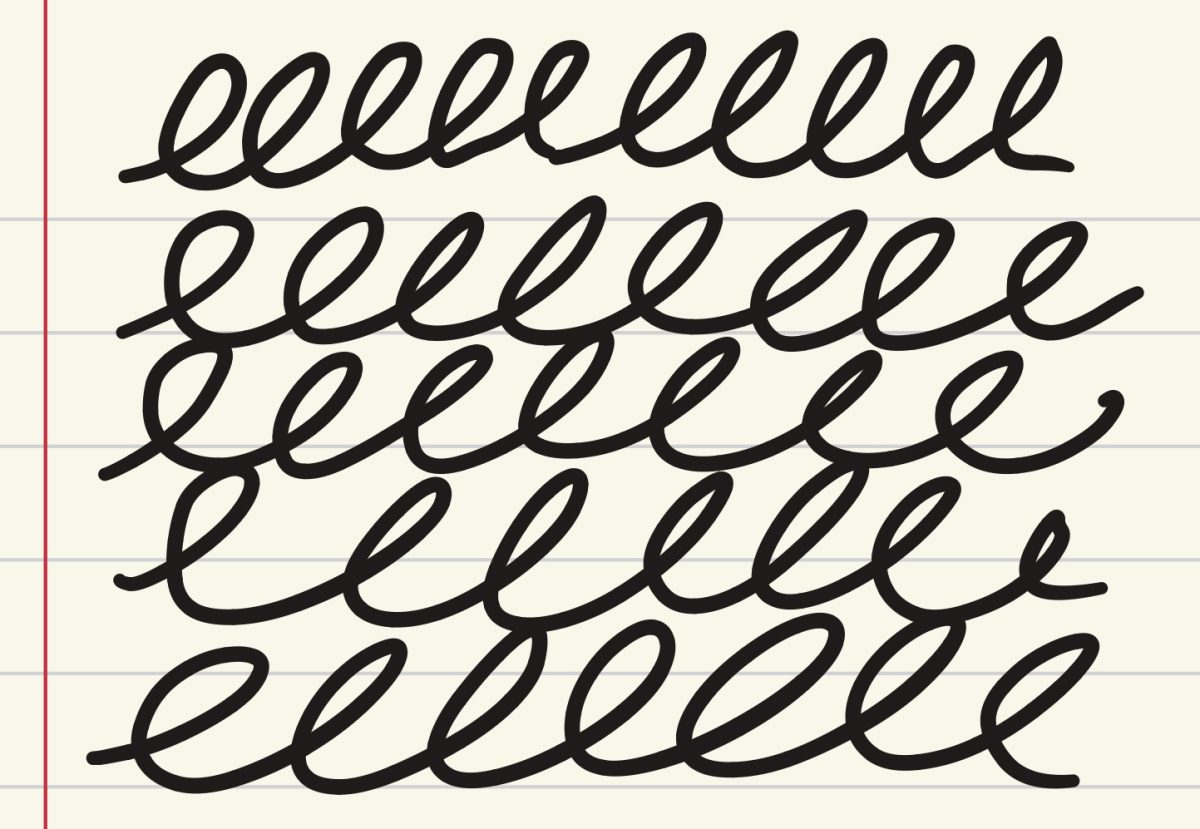
I’d never learned cursive in school, so I began to practice in whatever free time I could find. Late nights, mostly. But as I practiced, I started to realize that cursive might have much more to offer than excessive loops and flourishes.
First, in cursive, I’m working without a net. There are no edits, no redos. If I lift the fountain pen from the page, the ink will drip, so planning is key. I have to be confident about what I’m writing the moment I put pen to paper. It’s weird. I was so used to scribbling down notes with erasable pencils and typing up articles as fast as I could think that slowing down to focus on the letters themselves felt kind of relaxing, meditative even. In a 2025 study by Giuseppe Marano and others, it was suggested that cursive writing can be directly beneficial in this way.
“Cursive writing involves greater activation of the motor cortex and cerebellum, as it requires fine motor coordination and smooth transitions between letters,” the team wrote. “This fluidity enhances memory retention and cognitive engagement, as the writer must anticipate the next letter in a continuous motion.”
Cursive also encourages improvisation. If I slip up, I need to remember to keep my pen moving, creating a new line that takes me where I need to go. As a result, I’ve begun to second-guess myself much less in creative writing and note-taking. In an article from 2023, Maggie Downs cited similar studies to support this.
“The fluidity of cursive allows for smoother, uninterrupted writing, enabling students to focus more on the content they are producing rather than the mechanics of forming individual letters,” Downs wrote. “This fluency can lead to increased writing speed and efficiency, facilitating note-taking and expressing ideas more fluidly during examinations or class discussions.”
But mostly, I just love making words into art. Beyond any lingering practicality, there’s an elegance, a mindfulness, and a sense of personality that cursive brings to writing. The intention and care that go into making a message more beautiful also make it more meaningful. These days, writing to someone in cursive is a way to say, “Hey, I made you something.” And maybe that’s why it’s worth learning.
“P.S. Please excuse the inkblots, I’m still practicing.”