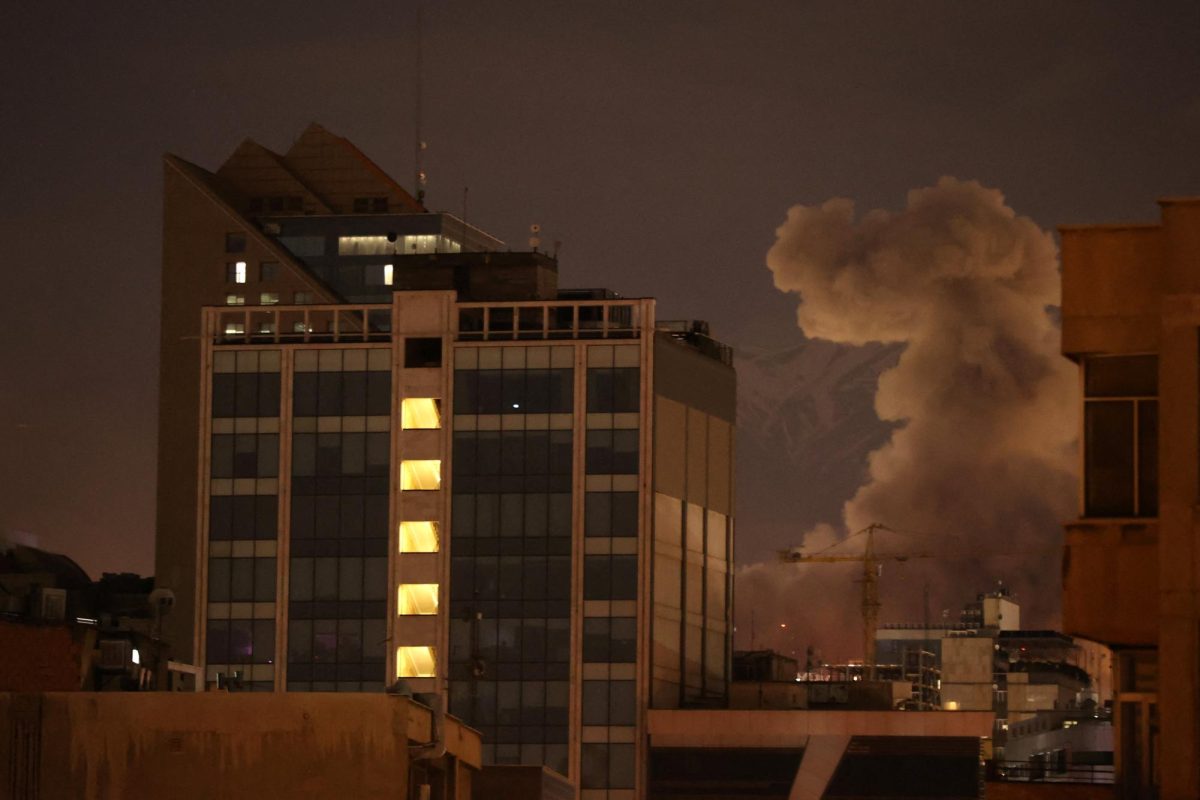
On the morning of Saturday, Feb. 28, the United States of America and Israel launched a coordinated sweeping military attack against the nation of Iran. The goal of the operation is to unwind the Iranian government and extinguish any threat of Iran being a nuclear power. The operation was targeted to kill high-profile leaders as Trump urged the Iranian people to overthrow their government and to start anew.
As the day went on, Israeli Prime Minister Benjamin Netanyahu claimed that Iranian Supreme Leader Ali Khamenei had been killed in an airstrike after decades in power. After several hours, this was confirmed by the Iranian media. After Khamenei was killed, a new Iranian transitional council was formed to run the government. One official reportedly told CNN that “Donald Trump has crossed a very dangerous red line.” (CNN)

The operation (named “Operation Epic Fury”) that President Trump has been promising against the Islamic Republic of Iran for weeks has come to fruition. There have been tensions between Iran and the American-Israel coalition ever since the Iranian revolution in 1979. Their tensions have become more strained as Iran’s violent crackdowns against protesters and their concern as a nuclear power have grown.
More specifically, the strikes came after negotiations between the US and Iran regarding the latter nation’s nuclear weapons program. In June of 2025 Israel, which has played a major role in the attacks of Feb. 28, and the US launched attacks against facilities in Iran dedicated to the development of nuclear weapons. This has led to a growing tension between these countries.
Last week the US massed forces across the Middle East in the Persian Gulf and Mediterranean Sea while holding negotiations with the Iranian leadership. In the Arabian Sea, the US deployed the Lincoln Carrier Strike Group headed by the USS Abraham Lincoln.
In addition, the American and Israeli strikes targeted the Iranian-allied Shia militia groups in Iraq.
The current strikes have been more sweeping than those in June and are targeting more than just nuclear infrastructure and senior leadership. However, it isn’t just Iranian leaders being impacted. There have been hundreds of civilian deaths all across the Middle East.
“I’m not in everyday contact with my family there, but I have really close family friends who are there: my aunt and uncle who live in major cities, as well as all my cousins,” said Liliana Amjadi-Klass, a CHS Sophomore. “This should definitely not turn into war. I definitely think that.”
One of the biggest human losses came from the bombing of a girl’s elementary school in Minab. The estimates of deaths in Iran are over 500 people, with hundreds more injured. Three US soldiers were killed, and five others have been reported injured. There have been 12 deaths in Israel, with several more injured.
“I saw three casualties lying on the ground with no signs of life and had to pronounce them dead at the scene,” Dror Eini, MDA paramedic from Israel, said. “We saw destroyed homes, flames and smoke rising from residential buildings, wrecked cars, and significant chaos at the scene.”
Iran is striking back, with explosions and drone strikes across the Gulf States of Bahrain, Qatar, the United Arab Emirates (UAE), Saudi Arabia and Kuwait. All of these kingdoms host major US military bases, which have also been targeted. In Dubai, the capital of the UAE, the five-star Palm Jumeirah hotel was set on fire by an Iranian missile attack. An Iranian drone struck a high-rise in Kuwait, and the numbers of those injured in the Gulf States are still coming out.
Israel, Saudi Arabia, Jordan and the Gulf States have shot down many of the missiles coming out of Iran since the opening of the retaliation. Explosions have still rocked American military bases across the region, including the largest American military base in the Middle East, Al Udeid Air Base in Qatar.
The result has been chaos across the region, and flights out of major airports across the Middle East have been cancelled, especially in the Gulf States, Israel and Lebanon. Many nations, including Israel and the Gulf States, have closed their airspace as missiles continue to fly.
The UAE and the other Gulf States have been considered a bastion of stability in a region that has seen numerous large conflicts erupt in recent decades. Strikes continued throughout the weekend with Hezbollah, an ally of Tehran in Lebanon, attacking Israel to its south. Israel has responded with airstrikes in the capital Beirut. For now Americans can only watch this developing crisis as this multi decade-long clash between the US/Israel duo and Iran comes to a new boiling point.